Showing posts with label Long-tailed Tit. Show all posts

Monday, 6 November 2017

Sound Recording - Cowley Woods 1st November

I have spent many years recording and analysing bat calls as part of my work and have often considered experimenting with bird sound recording but have never done so. Having read the recent article on night sound recording in Birdwatch magazine and seeing the various samples posted on the Portland Bird Observatory website I thought I would finally give it a try. Initially I borrowed a Tascam DR05 from work but I quickly found that this recorder was not suitable (despite good reviews) for recording bird sounds. I found that the recordings were low level and that the playback on the recorder was poor, I considered that the ability to playback a recording at reasonable volume was important. After some research I opted for the Olympus LS-14 and although I tested the inbuilt microphones i found that these were not good enough for anything but the closest of birds. So I then tested a Sennheiser video-microphone that I have had for years but I couldnt get this to work. Finally after digging around I found my Sennheiser ME66 microphone which, again, I have had for many years but barely used. This was, and I believe still is, considered to be one of the best directional microphones for recording bird sounds. My research indicated that the Telinga set-up is the ultimate but this is a considerable financial outlay for one just commencing in bird sound recording.

I then investigated software for analysis of recorded bird sound and after some fairly quick research I decided that the Raven software was a good starting point. Having downloaded the free Raven Lite and watching a number of tutorial videos and reading some of the user manual I found this a fairly straightforward piece of software to get to basic grips with. I then opted to download the Raven Pro one year licence for USD100 with a view to extending this licence if my interest took off.

On 1st November I had my first opportunity to test my kit and here are a few recordings from wandering around Cowley village and to Cowley Woods near to Cheltenham. The calls were uploaded to Sound Cloud and the sonograms were generated in Raven Pro.

First I encountered a flock of Long-tailed Tit and recorded their 'zerrr' call. The sonograms generated remind me of horse heads with the higher pitched 'ze' element of the call forming the head and the lower pitched trilling 'rrr' the body of the horse.


 I then recorded this singing Robin. The recording levels are a little high and therefore there is some distortion to this recording but the sonogram shows some of the complexity of the song.


Here is a fairly distant (c.200m) Great-spotted Woodpecker showing its broadband 'pic' call.


I then encountered a flock of around 50 Redwing and in this sonogram the familiar 'seep' calls at around 7kHz and and low inverted 'V' of the 'gack' call at around 2.50 kHz at 0.4 and 2,5 seconds can be seen and heard,


Finally, at sunset this flock of House Sparrow were socialising just before settling down to roost. The sonogram is so busy that its simply fuzz from the shear level of calling by the birds.


So, I think that this is a fair start but initially I notice that there is a lot of noise to my recordings particularly in the lower frequency. I suspect this is simple background noise from the recording device as the frequency of this noise seems to be consistent across all recordings. There is a way to filter this noise in Raven Pro and I began to get to grips with this in the Robin recording, this reduced noise can be seen in the sonogram above which has a reduced fuzz along the bottom of the sonogram. During my investigations to find suitable kit to commence sound recording I found the following websites very useful and I hope they are useful for you if you decide to embark on this rapidly evolving element of birding.

Resources
ABA Blog - How to Record Birdsong Part 1
Audubon - A beginners Guide to Recording Bird Vocalisation's
Ear Birding Blog
How to Visualise Bird Sounds
Macaulay Library - Audio Recording Techniques
Raven Sound Analysis Software
Sound Approach
Understanding Sonograms
Wild Mountain Echoes

Friday, 27 October 2017

Portland, Dorset - 27th October

I arrived at Portland at 07:30 just as the sun was rising and overhead Meadow Pipit, Sky Lark, Alba Wagtail and Linnet called. During a coffee before setting off and waiting for the sun to rise I spotted a couple of thrush in the scrub along the West Cliffs, chacking calls gave them away as Ring Ouzel so I set-off to get better views. I eventually had fairly good views of a male and female as they fed on Blackberries and Privet berries on the scattered scrub. I birded the west cliffs for a while before dropping down to the observatory. Woodpigeon passed in good numbers overhead and Brambling and Redpoll could be heard calling as they passed over. I birded the Hut Fields and then along the East Cliffs before heading up to Culverwell the highlights being two Firecrest, four Yellowhammer and two Golden Plover. At Culverwell, the southern edge of the scrub was bathed in sunlight and there were good numbers of insects, there were at least three Chiffchaff and a few Goldcrest. I then picked-up what looked to be a fairly pallid Acrocephalus and my immediate impressions were that it was simply a pallid looking Reed Warbler. Other birders approached and it became apparent that there was a rumour that the bird was a Marsh Warbler, this identification morphed into Blyth's Reed Warbler and as the crowd swelled to around 30 this identification took hold. I however was a little sceptical, to me it simply looked wrong in tone being too warm and seemed to have the wrong jizz - I couldn't put my finger on it but it just didn't feel right for a Blyth's Reed. Still I watched the bird for an hour or so before heading back to the car and home. When home I quickly looked at my images of the Acrocephalus and became more certain of my doubts so emailed some images and thoughts to Martin Cade - a little later that day the bird was captured and its identity as a Reed Warbler confirmed.  Martin's account of the day can be read on the Portland Bird Observatory website here.

Ring Ouzel - West Cliffs, Portland

Migrating Woodpigeon - Portland Bill

Little Owl - Observatory Quarry, Portland

Meadow Pipit - East Cliff, Portland

Reed Warbler - Culverwell, Portland Bill

Reed Warbler - Culverwell, Portland Bill

Long-tailed Tit - Coastguard Cottages, Portland

Mornings Totals:
Golden Plover - 2
Lapwing - 1
Woodpigeon - 350
Ring Ouzel - Male and female West Cliffs, on heard at Obs
Redwing - 8
Chiffchaff - 8
Firecrest - 2
Long-tailed Tit- 8 
Reed Warbler - 1
Blackcap - 3 (2 male and a female)
Stonechat - 35
Brambling - 5
Redpoll - 6
Siskin - 35
Reed Bunting 6
Yellowhammer - 4

Thursday, 28 September 2017

Spotted Crake, Hornchurch CP and Red-necked Grebe, Roding Valley Meadows - 28th September

I had a bit of an epic survey day today, leaving home at 05:00 I was at Dagenham Docks (even less glamorous than it sounds) by 07:15. After this survey I had to cross Greater London in a north-west direction to St Albans. So having started so early I had a little time to play with and a couple of birds en-route.

First-up I visited Hornchurch Country Park in the Ingrebourne Valley where a Spotted Crake has been present since 16th September. The bird showed well soon after I arrived and I enjoyed excellent views for the time I was there. Also here were Water Rail (two), Cetti's Warbler (six) and a handful of Teal, Gadwall and Snipe. I have seen around seven Spotted Crake in the UK but not for many years and I have never photographed the species. It was a cracking little bird showing fairly well in an area of cattle grazed flooded swamp.

Spotted Crake (juvenile) - Hornchurch Country Park

Spotted Crake (juvenile) - Hornchurch Country Park

Spotted Crake (juvenile) - Hornchurch Country Park

Spotted Crake (juvenile) - Hornchurch Country Park


Spotted Crake (juvenile) - Hornchurch Country Park

Spotted Crake (juvenile) - Hornchurch Country Park

Next I visited Roding Valley Meadows near to Chigwell where a juvenile Red-necked Grebe has been present since 22nd September. While I have seen many Red-necked Grebe I have not seen the species in juvenile plumage so was keen to see this bird as I was pretty much passing by on route to St Albans. The bird was fairly mobile and often distant on the lake but eventually showed well in a secluded corner in the north-west of the lake. 

Long-tailed Tit - Roding Valley Meadows, Chigwell

Red-necked Grebe (juvenile) - Roding Valley Meadows, Chigwell

Red-necked Grebe (juvenile) - Roding Valley Meadows, Chigwell

Red-necked Grebe (juvenile) - Roding Valley Meadows, Chigwell

Red-necked Grebe (juvenile) - Roding Valley Meadows, Chigwell

Monday, 26 January 2015

Extremadura - 18th January (Day 3 of 4)

We awoke at 06:30 to rain as was forecast despite the doubts we had of the accuracy of the forecast of rain the evening before. After a quick breakfast we headed out and drove north back through Monfrague National Park to Navaconcejo where we stopped at the Rio Jerte for Dipper here in Extremadura of the race 'aquaticus'. After a bit of scanning we eventually picked up a bird feeding on rocks in the middle of the river, after driving parallel with the river a short way we eventually got good views as it sang and fed in the middle of the river although it was still a little dark and murky for a decent photograph. We then headed up over the pass through the Tras la Sierra (Extremaduran Gredos) towards the pass at Puerto de Honduras where Ricardo had a site for our main target, Iberian Green Woodpecker and also for Citril Finch, but as we climbed the snow became thicker until we decided that the road was not going to be passable so after reversing some distance back down the road as it was too narrow to turn we headed back through Navaconcejo and took the lower pass via Puerto de Cabezabellosa. We then drove up the highway to the forest at Hervas where eventually after almost three hours on the road we reached our destination. We parked at the end of a rough track and walked through the very English like landscape consisting of small pastures and woodland blocks. The woodland here was dominated by ash, poplar and oak and it was not long before we heard the familiar yet noticeably high pitched 'yaffle' call of Iberian Green Woodpecker. After much scanning and playback I eventually picked the bird up rather distantly feeding on the ground, it looked fairly similar to 'our' Green Woodpecker but with less black on the face, and seemingly more green washed underparts. We tried to get closer views but to no avail. Other birds here were Nuthatch, Cirl Bunting, Iberian Azure-winged Magpie, Rock Bunting, Long-tailed Tit of the race 'irbii' and Serin.

Dipper of the race 'aquaticus', one of the black-bellied races at Navaconcejo
Snow bound road on way to pass at Puerto de Honduras
Habitat at Hervas. Iberian Green Woodpecker was the target here and was seen foraging in the meadow and calling from the ivy clad Poplars at the left side of this image.
Long-tailed Tit of the race 'irbii' with grey rather than pinkish scapulars at Hervas
Male Cirl Bunting at Hervas

We then headed back south on the E-803 highway but cut off at La Granja and passed through Tierras de Granadilla. This was an area of arable fields and holm oak studded pasture which we simply drove through with occasional stops but which yielded several hundred Common Crane, many White Stork, a roost of nine Stone Curlew, Thekla Lark and many of the other now familiar roadside birds. 

Flock of Common Crane at Tierras de Granadilla
Common Crane at Tierras de Granadilla
A stop at a pool at Fresnedillas produced several Crag Martin, Wigeon, 
Shoveler and Great White Egret
Thekla Lark at Tierra de Granadilla
White Stork were by now a familiar site nesting on a range of elevated structures

We then headed for the rice fields at El Batan. This rather unattractive area, consisting of flooded fields used for rice production and seemingly derelict factory farm buildings, was nonetheless very birdy. Our first stop at a flooded rice field pool produced Ruff, Greenshank, many Snipe, Green Sandpiper and a Lesser Yellowlegs which showed well and has been present since November. A Bluethroat showed very well as it worked a feeding circuit around the pool and eventually approached to within 10m or so. A Water Pipit also gave similarly excellent views. We spent the rest of the day birding this area seeing many hundreds of White Stork, Sardinian Warbler, Dartford Warbler, Zitting Cisticola, Hen Harrier, Little Owl, another Bluethroat, Hoopoe, many Spanish Sparrow and small flocks of introduced Red Avadavat and Common Waxbill. 


Lesser Yellowlegs at El Batan. This adult bird has been present since November 2014
Green Sandpiper at El Batan
Bluethroat at El Batan
Little Egret at El Batan
Water Pipit at El Batan
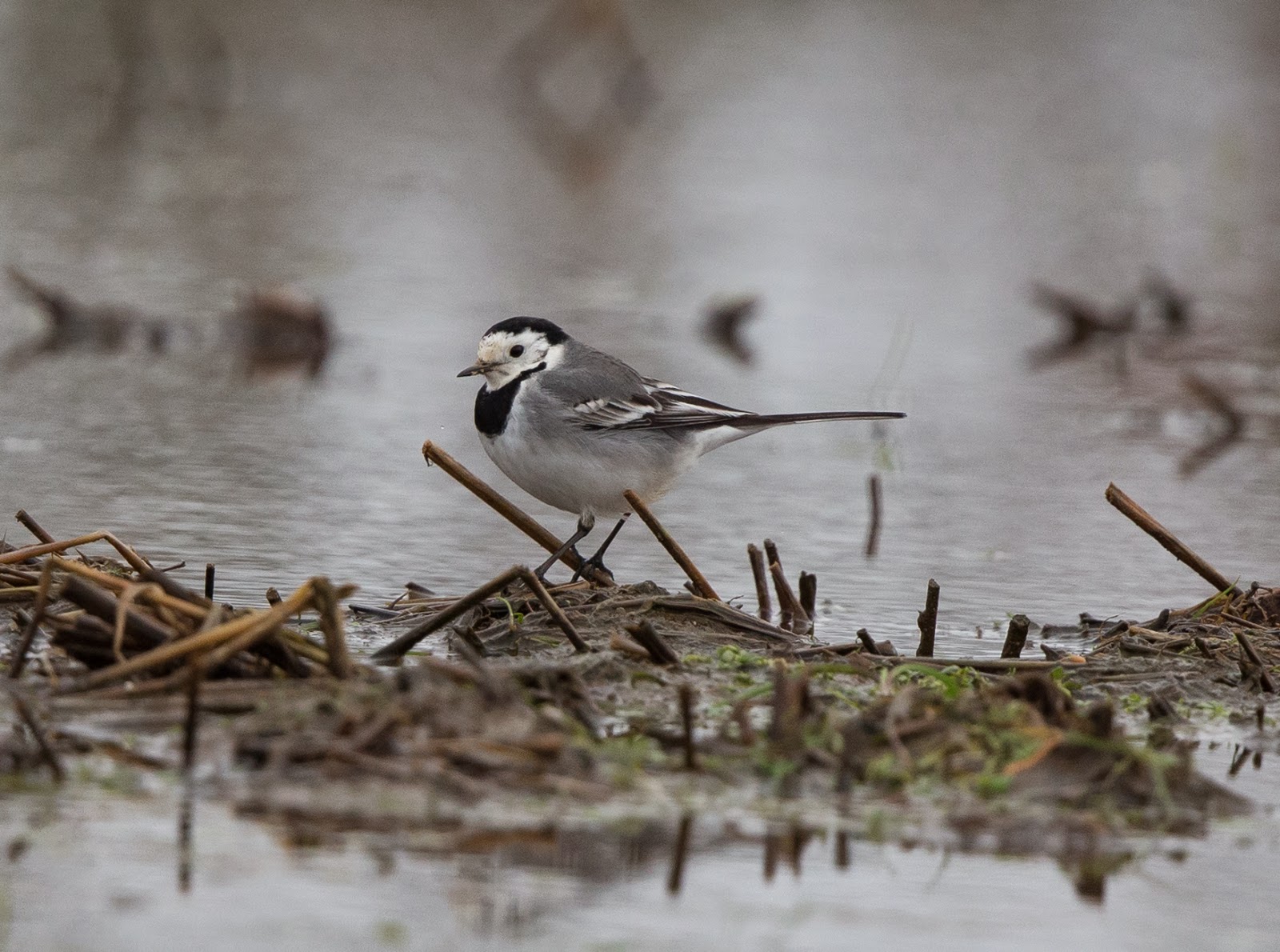
White Wagtail at El Batan
Common Waxbill at El Batan. A flock of around 20 of these smart introduced birds was present
Red Avadavat at El Batan
Male Stonechat at El Batan
Spanish Sparrow at El Batan. This is an abundant species in Extremadura
Part of a flock of around 300 White Stork at El Batan
Little Owl at El Batan
Hoopoe at El Batan


We finished the day at the rocks of Salto del Gitano in Monfrague National Park where we watched the Griffon Vultures spiralling round the cliffs and watched large flocks of Wood Pigeon pass over head to roost. We waited until after dark when, just at the last embers of light, we heard the distinctive 'whoo' of an Eagle Owl, somehow, Richardo managed to pick the bird out sitting right at the very top of Pena Falcon and through the scope the ear tufts were just visible in the darkness and at considerable distance. We headed back to the accommodation for 19:30 after another full and productive day in the field.


These are the rocks at Salto del Gitano in the Monfrague National Park. Amazingly, Ricardo picked out an Eagle Owl in near darkness at the very top of Pena Falcon, the middle peak of rocks. The birds flying around this cliff face are Grffon Vulture
Flocks of Wood Pigeon are always an impressive site

Here are the links to the other days of the trip: