Introduction
I have been visiting the Isles of Scilly since 1986 when I was a whippersnapper and a mere 15 years of age. I have been most years often on multiple visits in a year and have visited in all months with the exception of February and November. I love the islands and classify them as perhaps my favourite destination. This was our second trip to the islands with Tobias, he first came when he was three months old in July 2013. I was quite looking forward to the holiday since now he is walking we could get to places inaccessible with a buggy and his slow pace is great for birding! So I had high hopes of finding a mega, and with the recent easterlies I fancied an Asian species - I was not to optimistic, a Red-flanked Bluetail would be fine. As is now tradition, we stayed in the Star Castle, a far cry from some previous trips where I have been known to sleep in the ISBG hide on Lower Moors in my younger years. We caught the 16:10 flight from Lands End on the 24th September and chilled out that evening.
25th September
The day started early for me, it was my birthday, a mere 43 years old and as is tradition I try to be at a location where I am positioned to find, or at least see, a rare bird. The alarm went off at 06:00 but being a little further west than home I hadn't appreciated that it was completely dark outside at this time. So I had a coffee in the garden of our digs and watched the sunrise.
Sunrise on my Birthday looking towards the incinerator from Star Castle
My aim for the pre-breakfast birding was to head for Lower Moors for the Bluethroat that had been present since 23rd September and then head for the allotments at the hilt of Peninnis Head for the Barred Warbler and onwards to the head of Peninnis (excuse all the puns!!) for one of the two Wryneck. So I got to the hide at Lower Moors as it was getting light and positioned myself. It was then I realised that I didnt know where this bird would/could appear so a quick chat with
Spider and he gave me precise directions, 'It usually appears to the right of the triangle stone and works its way along the edge of the reeds to the south corner of the pool before disappearing into the reeds for two hours'. Thanks Spider, okay, time to focus.
Map of St. Mary's
Nice views of a juvenile Ruff working its circuit around the pool, good views of Snipe, an obliging Kingfisher, a Sedge Warbler and a Grey Heron, that was it. I sat and waited, the sun was shining the hide was hot and my attention drifted. A twiddled with my camera and then looked up, whats that, a movement on the opposite side, probably just the Sedge Warbler again, I put my bins up and BOOM, a bird with a sparkling blue throat perched on a reed stem, that must be the Bluethroat then - it was 08:15. There it was in full view and it sat there for a full 10 seconds, I thought to myself, 'oh it shows well'. And then it flicked and dropped into the reeds and for the next five minutes or so it fed secretively along the reed edge often disappearing for a while before reappearing, and it then flicked and disappeared into the reeds and sedges to the south, I waited and waited, this was definitive, gone for two hours. If only I had grabbed my camera when it was on that reed stem! I glanced at my watch and it was 08:45, not time to head for Peninnis before breakfast, bugger, so I birded the willows back to the road and slowly birded back to the hotel via Porthmellon Beach seeing little en-route.

Ruff - Lower Moors
Snipe - Lower Moors
Grey Heron - Lower Moors
Kingfisher - Lower Moors
After a good breakfast we headed over to Tresco, I wanted to try my luck at finding a rare, and bar a couple of Curlew Sandpiper and a Little Stint there had been nothing reported from Tresco. I find Tresco a little commercial, perhaps even slightly pretentious, but it is a beautiful island and has a great track record for rares. Walking was slow with Tobias now that he is on his feet but that was fine by me, a good birding pace. We walked from the quay at Carn Near in the south of the island north-east via Oliver's Battery, cut across the helipad, and along Abbey Drive to New Grimsby before cutting to Old Grimsy for lunch. I saw incredibly little, 4 Goldcrest, 3 Ruff, 1 Blackcap, 2 Chiffchaff and around 20 Swallow and 1 Sand Martin - with the 25c temperatures and lack of migrants it felt like the summer. Anyway, lunch at The Ruin Beach Cafe was great, topped off with some birthday champagne!
Map of Tresco
Adult Swallow - Towns Hill, Tresco
Juvenile Swallow - Towns Hill, Tresco
After lunch we walked back south along Borough Road and then back along Pool Road, again it was incredibly quiet, 2 Whinchat at Vane Hill and 3 Wheatear. I had a reminisce about a Yellow-breasted Bunting on my Birthday in the fields at the south end of Borough Road on this day in 2000, a world tick for me then and still the only one that I have seen. We headed back to New Grimsby for our 15:45 ferry back to St.Mary's.
After landing back on St. Mary's I headed up to the allotments at Peninnis to have a look for the Barred Warbler and Wryneck, neither of which had been seen today. I spent around 1.5 hours looking but nothing, not a sniff, but around 15 Wheatear on Peninnis. That was it, back to the Star Castle for dinner and a small pub crawl in Hugh Town. On our return at 10:30 a Manx Shearwater was on the road outside the Star Castle, presumably dazzled by the lights of the hotel, so I captured it and released it away from the lights further along the Garrison.
26th September
Another early start and I birded the Garrison at first light walking through the campsite, down to Morning Point and back along Lower Brome Platform. It was slow going, 2 Wheatear, 2 Chiffchaff and little else of note. Back to the hotel for breakfast and then we headed out to wander St. Mary's, we walked back around the Garrison, through Hugh Town, up to Peninnis, down to Old Town, through Lower Moors and then for lunch at Juliets Cafe. Slow going again, 20 Wheatear on Peninnis, a Whitethroat at Lower Moors and around 5 Chiffchaff.
After lunch we wandered up to Telegraph and Watermill and back down the centre of the island. A Green Sandpiper on Newford Duck Pond got the heart going, its location and tame nature was far more Solitary Sandpiper than Green Sandpiper but it was not to be. Great views of a Green Sandpiper
Green Sandpiper - Newford Duck Pond
Green Sandpiper - Newford Duck Pond
Sarah and Tobias went back to the room to get ready for dinner and I had a quick wander back to the campsite to look for one of the three Yellow-browed Warblers that had been reported and almost immediately, as I approached the Tower Garden, was the distinctive 'swee-wee' of a Yellow-brow. I watched the bird feeding in the pines, birch and elms in the garden but the bird was always a little elusive for the camera - or rather too fast for my reactions! Fantastic little bird though and an amazing journey it must have undertaken to get to St. Mary's.
Yellow-browed Warbler - Tower Garden near to the campsite
27th September
Another early start and I again walked the Garrison, through the campsite and along Lower Brome Platform. Again it was relatively quiet, the Yellow-browed Warbler was present but a little more elusive and then as I walked th path through the centre of the campsite a pale spot caught my eye in the pines by the Woolpack accommodation block, a Red-breasted Flycatcher, billiant - a self found, always good. I watched it for while as it fed through the pines, again always a little elusive of the camera. There was little else around, much as was seen yesterday.
Red-breasted Flycatcher - Woolpack Accommodation Bloack
After breakfast we headed over to St. Agnes, one of my favourite islands. We did a loop of the island walking from the quay past Porth Killier around the Big Pool to Periglis Cove and then around Carnew Point via the campsite, past the Old Coastgaurd Cottages to Barnaby Lane via the Parsonage and around Wingletang Down and back to the Turks Head for lunch.
Map of St. Agnes
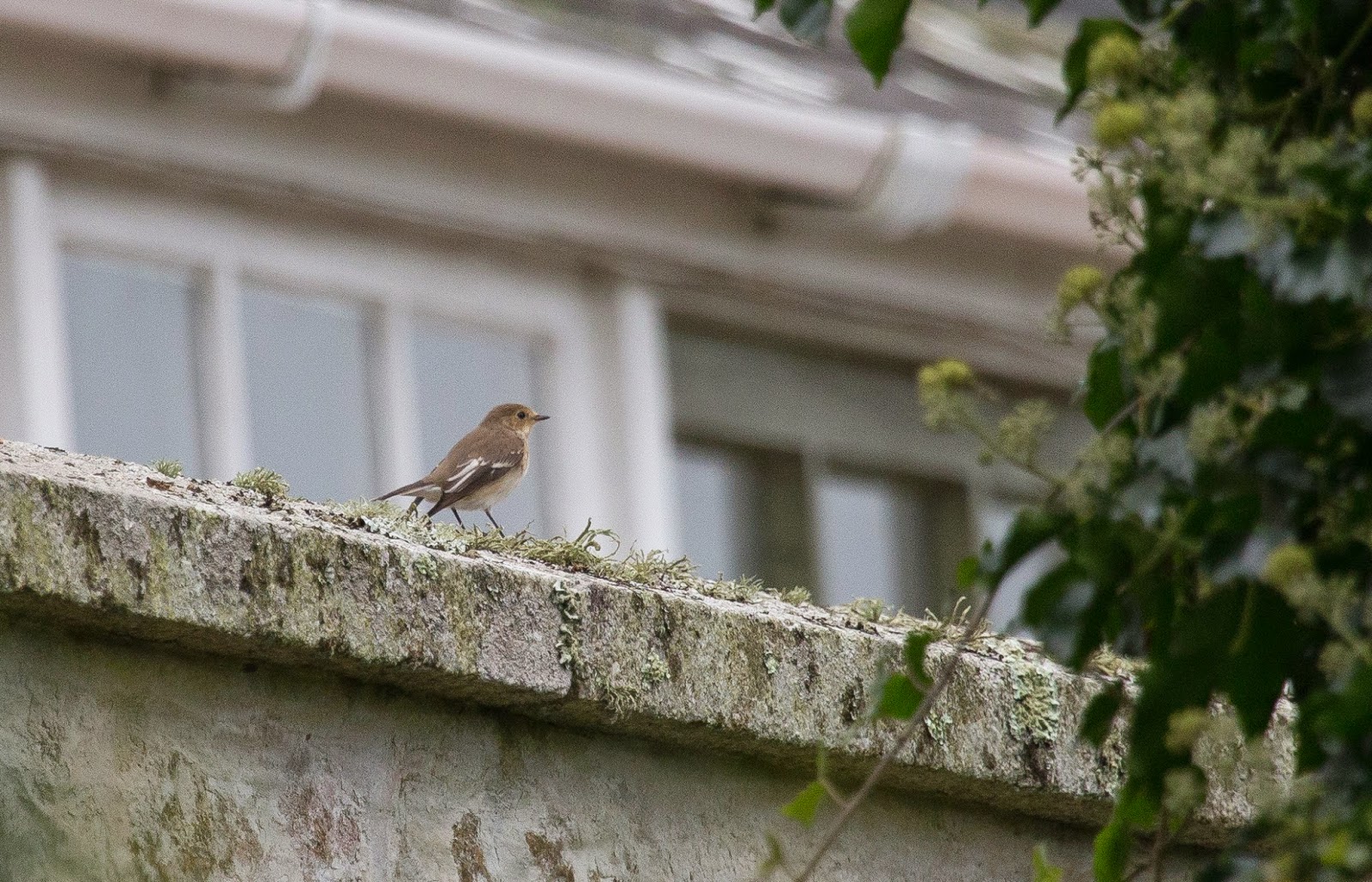
Migrants were again in short supply with 5 Chiffchaff, a Curlew Sandpiper in Periglis Cove and a Pied Flycatcher and a Spotted Flycatcher in the Parsonage. The highlight came at lunchtime as a Richard's Pipit called loudly overhead and flew over Porth Conger heading to Gugh and then over Gugh heading towards Peninnis Head.
Rock Pipit - Browarth Point
Chiffchaff - Big Pool
Curlew Sandpiper, Dunlin and Ringed Plover - Periglis Cove
Specled Wood of race insula found on the Isles of Scilly. It differences from the nominate race in the following ways;
- The upperside has better-developed orange markings, especially those surrounding the spots on the hindwing;
- The underside of the forewing has orange, rather than cream, markings toward the centre; and
- The underside of the hindwing has a darker purplish-grey area at the margin, providing more contrast.
Stonechat - Porth Askin
Pied Flycatcher - The Parsonage

The Parsonage Garden
House Sparrow - The Turks Head
View from The Turks Head showing the bank of cloud of the morning shifting away to
give a hot and sunny afternoon
After lunch we wandered back up to the Parsonage and back towards the great pool before catching the 15:45 ferry back to St. Mary's. I left Sarah and Tobias shopping in Hugh Town while I had another try for the Bluethroat. The pool at Lower Moors supported much the same as on 25th with the addition of a Greenshank. After half an hour I had fleeting views of the Bluethroat once more. I managed two photographs, both can truly be defined as 'record shots'!
Bluethroat - Exceptional Record Shot from ISBG Hide on Lower Moors. You can just about imagine some blue!
On the way back to the hotel I had this Wheatear perched in a palm, it was an odd site, I felt I needed a beer.
Wheatear - Garrison Arch
28th September
Once again I was up early and birding the Garrison before breakfast. Not much to show for it though. After breakfast we headed for the boats and decided to go to Bryher. I have never been a fan of Bryher for some reason but Sarah loves it, I am not sure what it is about the island that I am not too fond of, not sure if its a couple of previous dips there or the rubbish dump which seems to be almost focal to the island. This time though I warmed to it, especially the south of the island around Sampson Hill and Heathy Hill.
Map of Bryher
However, it was still very slow going in the hot summer like conditions. Before lunch we walked from the quay past the Fraggle Rock, through the campsite and out to Popplestone Brow before cutting back to the Hell Bay Hotel for lunch. We saw hardly anything of note, 20 Meadow Pipits, 2 Chiffchaff, my first Willow Warbler of the trip and narrowly dipped a Rose-coloured Starling at the Vine Cafe - boring birds anyway!
Willow Warbler - Near to Fraggle Rock Cafe
Bryher from Timmy's Hill showing Great Pool and Great Popplestone
After lunch we walked south and around Heathy Hill and Sampson Hill seeing a couple of Wheatear, a Whinchat and the Hooded Crow that has been resident on the island since the early 'noughtys'. A pallid looking Chiffchaff at The Green got the pulse racing but it was noting more than a standard Chiff, perhaps with a little eastern blood. And that was that, back on the ferry and a quick bird around the Garrison which yielded a Yellow-browed Warbler and nothing else.
29th September
The final morning before our 11:11 flight back to Lands End and I was up early and wandering across the campsite towards the woolpack accommodation block. Very little around so at the Woolpack I decided to turn and head back for breakfast and to pack for the flight but then I caught a movement in the Pittisporum bushes flanking the Woolpack Battery, I raised my bins and there, clearly, was an Acrocephalus warbler, but where were the rufous tones of a Reed Warbler, and then it called 'tack, tack tack' BLOODY HELL!! It must be a Blyth's Reed Warbler, I had no more than 10 minutes before having to leave so I wapped off some photos, summoned a couple of birders and watched as much as I could. It came to the top of some Bracken, surely there would show rufous tones now it was in better light but no, this bird was grey/brown. The tertials looked plain, the wing looked short but something just didn't seem right for Blyth's, I checked my watch - damn it I had to go, 10 minutes on a bird that needed at least an hour. A quick breakfast and off to the airport for the flight to Lands End.

Acrocephalus at the Woolpack Accommodation Block
Acrocephalus on the Woolpack Accommodation Block
However, once home and reviewing my photographs I came across this next chance shot and believe that it clinches the identification. The photo shows Primary 3 (P3) being more or less equal to P2, P1 is minute and just visible in this shot so that P2 forms the leading edge of the wing (i.e. is the first obvious primary) and P3 is the next feather in. In Blyth's P2 is equal in length to P5 whereas in Reed P2 is equal to P3. This bird appears to show a formula most closely matching Reed Warbler. Darn it!!
Acrocephalus on the Woolpack Accommodation Block
After leaving Scilly, and on arriving at Lands End, we grabbed our bags and had to head for St. Ives for the doctors surgery, Tobias had fallen in a Bramble bush on Bryher (quite appropriate really) and had to have some thorns removed from the palms of his hand, poor lad! He was braver than I thought when faced with a Cornish nurse and a needle! We had a walk at Portgwarra in the late afternoon but we saw little, two Chough, a Chiiffchaff and two Porpoise off shore. Night at our cottage at Trowan.
30th September
Another early start and I birded Cot Valley but it was desperately slow, a Firecrest was the highlight plus two Chough. I didn't even hear a Chiffchaff. Then down to Marazion Marsh but very little, it was remarkably dry - I am not fond of Marazion at the best of times. We spent the afternoon relaxing in St. Ives.
1st October
Packed our bags and headed home. No eastern mega.




.jpg)


