Saturday, 25 March 2017

Pennington Marsh - 23rd March

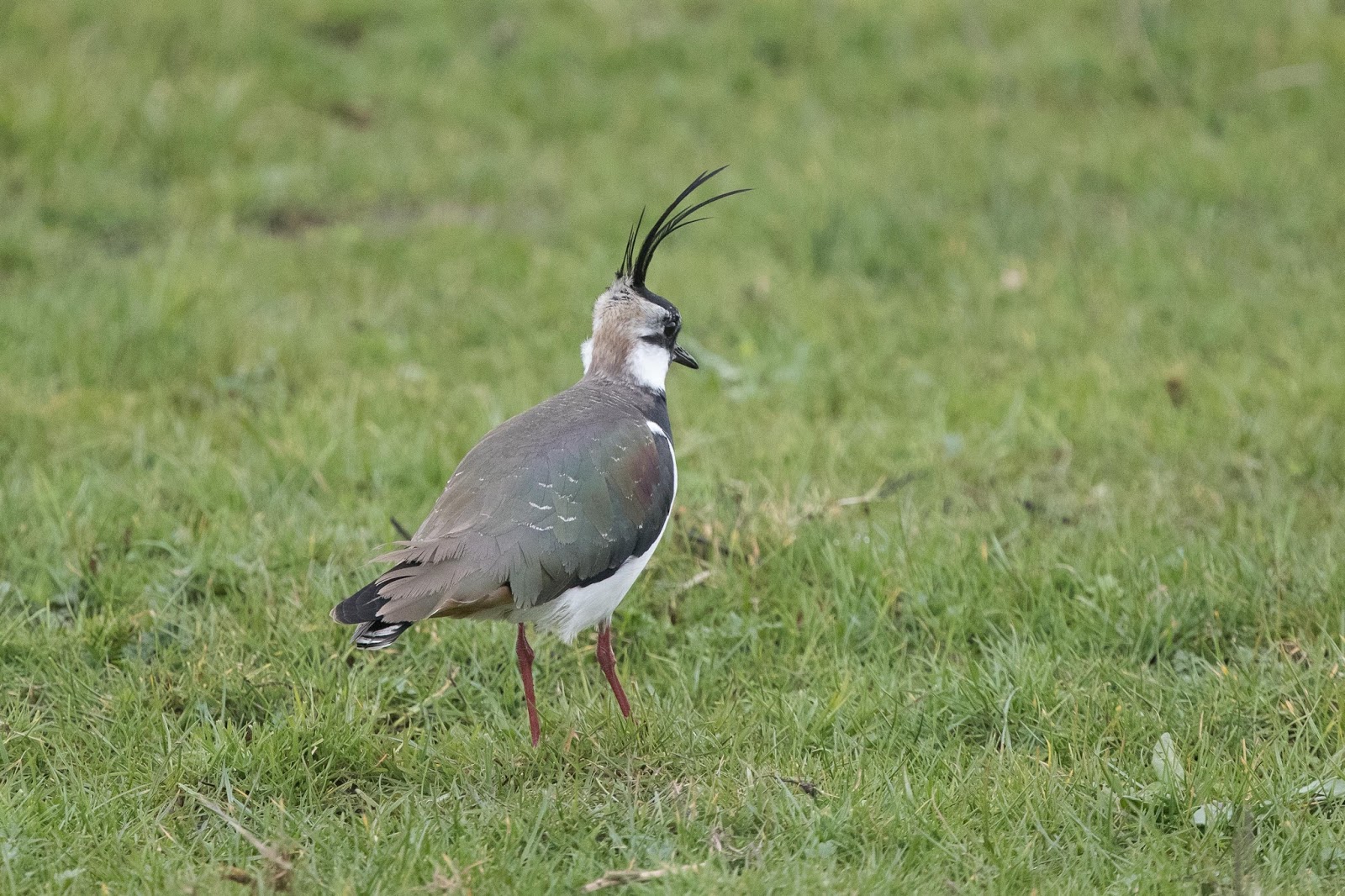
I was longing to get out birding as Spring is starting to feel like it is setting in and so after dropping Tobias at school in Lymington I headed to Pennington Marsh for a short walk. I stopped at the corner of Lower Pennington Lane where I had a coffee and scanned the marshes. There were a few Teal and Wigeon hanging on and small numbers of Brent Goose while singing from the willows were at least two Chiffchaff while overhead there were two House Martin, my first Hirundine of the year. Lapwing were displaying, what a fantastic sound they make, and I could see a few birds incubating within the grassland.

A wander to Efford Lagoon produced 15 Tufted Duck, a single Ruff and around 30 Pied Wagtail while gulls included Great Black-backed, Herring and around 75 Black-headed Gull.

A walk onto the seawall and there was a biting west wind blowing so I hurried towards Fishtail lagoon picking up a Slavonian Grebe, eight Pintail and small numbers of Turnstone, Dunlin, Grey Plover and Black-tailed Godwit. At Fishtail Lagoon a 1st summer male Marsh Harrier flew east and showed well flushing many of the Teal and Wigeon and at least three Snipe from the Lagoon. Best of all though were four Bearded Reedling busy nest building, two of the males showed very well along the reed edge and I spent some time enjoying these fabulous birds.

Bearded Reedling - Pennington Marsh

Bearded Reedling - Pennington Marsh

Bearded Reedling - Pennington Marsh

Bearded Reedling - Pennington Marsh

Lapwing - Pennington Marsh

Lapwing - Pennington Marsh

Lapwing - Pennington Marsh

Lapwing - Pennington Marsh

Lapwing - Pennington Marsh

Oystercatcher - Pennington Marsh

Oystercatcher - Pennington Marsh

Oystercatcher - Pennington Marsh

Oystercatcher - Pennington Marsh

Brent Goose - Pennington Marsh

Kestrel - Pennington Marsh

Meadow Pipit - Pennington Marsh

Great Black-backed Gull - Pennington Marsh

Great Black-backed Gull - Pennington Marsh

Turnstone, just entering summer plumage with some rufous appearing 
in the scapulars- Pennington Marsh

Marsh Harrier (1st summer male) - Pennington Marsh

Sunday, 19 March 2017

Cornwall - 16th-20th March

A long weekend in Cornwall and nothing much planned, I wanted to relax after a busy time at work, watch the final matches of the 6 Nations and drink some wine! But there were a few birds to see and I decided to bird on the morning of 17th before abandoning the bins and relaxing (unless of course something good was found).  So, on the morning of 17th I was up at 06:30 and on my way to Helston where a Bonaparte's Gull (1st winter) had been present on the boating since 5th March. I arrived at the boating lake at 07:30 and there was no sign of the bird but in the southern end of the lake was a flock of around 75 Black-headed Gull and I decided that this was the obvious place where the bird would appear. I waited for 20 minutes with no luck and then decide to walk around the lake seeing Shoveler, Tufted Duck, Chiffchaff and Grey Wagtail. By the time I returned to the southern end a brief scan revealed the Bonaparte's, obvious because of its small size even at a distance. For the next hour or so I enjoyed good views of this diminutive gull as it loafed amongst the Black-headed Gull and occasionally uttered a distinctive tern like call.

On 19th a morning on the beach with Nigel, Alice, Sarah and the boys found us playing rugby - of sorts! Off shore there were three Sandwich Tern, my first migrants of the year.

Bonaparte's Gull, note the black bill, blackish wing markings and neat trailing edge to the wing. Helston Boating Lake.

Bonaparte's Gull - Compare the wing and head pattern to the Black-headed Gull in the background. To me this species is intermediate between Black-headed Gull and Little Gull. Helston Boating Lake.

Bonaparte's Gull - Helston Boating Lake.

Bonaparte's Gull - Note the clean white underwing and bubble-gum pink legs. Helston Boating Lake.

Bonaparte's Gull. Helston Boating Lake.

Bonaparte's Gull. Helston Boating Lake.

Bonaparte's Gull - This image is roughly to scale with the Black-headed Gull below. 
Helston Boating Lake.

Black-headed Gull (1st winter) - Roughly to scale with the image of the Bonaparte's Gull above. The greater bulk and orange to red bill of the Black-headed is distinctive and obvious. While the dark tertial centres are said to be darker on Bonaparte's this is not obvious. Helston Boating Lake.

Bonaparte's Gull. Helston Boating Lake.

Bonaparte's Gull. Helston Boating Lake.

Bonaparte's Gull - Note the distinctive white underwing with neat dark trailing 
edge to the primaries and secondaries. Helston Boating Lake.

Bonaparte's Gull - Note the distinctive white underwing with neat dark trailing 
edge to the primaries and secondaries. Helston Boating Lake.

Shoveler - Helston Boating Lake

Shoveler - Helston Boating Lake

Coot - Helston Boating Lake

Coot - Helston Boating Lake

Rook - Helston Boating Lake

With time now pressing on I spent an hour on the Hayle Estuary scanning the saltmarsh at Lelant. I quickly found the three Cattle Egret reported yesterday and one of the two Iceland Gull plus a Spoonbill - quite a nice selection for such a small area of marsh. Other birds here were Bar-tailed Godwit (3), Greenshank (1), Pintail (5), Wigeon (c.150+) and Mediterranean Gull (3).

Cattle Egret (3) with Herring and Black-headed Gull - Hayle Estuary

Iceland Gull (1st winter) with Wigeon and Herring Gull - Hayle Estuary

Iceland Gull (1st winter) - Hayle Estuary

Iceland Gull (1st winter) with Black-headed Gull - Hayle Estuary

Spoonbill with Redshank and Lesser Black-backed Gull - Hayle Estuary

Spoonbill - Hayle Estuary

Spoonbill with Herring Gull - Hayle Estuary

Tuesday, 21 February 2017

Beaulieu Road Station and Romsey - 16th February

I paid a brief visit to Beaulieu road Station today in beautiful spring like conditions. There were at least two territory holding Woodlark singing along Bishop's Dyke and small groups of Siskin and Lesser Redpoll were conspicuous in the Silver Birch. The Great Grey Shrike showed rather distantly behind the main pool on Bishop's Dyke where there were also around 15 Teal in full display. These were spooked by a Marsh Harrier - the first I have seen at this site. Around the main pool there were hundreds of Common Frog in chorus - a raft of spawn had been produced measuring at least 10 square metres, I don't think I have ever seen this quantity of spawn before.

Woodlark - Bishop's Dyke, Beaulieu Road Station

Great Grey Shrike - Bishop's Dyke, Beaulieu Road Station

Marsh Harrier - Bishop's Dyke, Beaulieu Road Station

Marsh Harrier - Bishop's Dyke, Beaulieu Road Station

Back at home in Romsey two Chiffchaff were feeding on the first insects of the spring, they occasionally broke into song - spring is arriving.


Chiffchaff - Romsey

Tuesday, 14 February 2017

Waxwing at Whiteley - 14th February

Having been away in Vienna for the weekend the arrival of a flock of five Waxwing at Whiteley Retail Village on 11th February was rather gripping given they were such a short distance from home. So, on 14th February with a bit of free time in the afternoon I paid a brief visit to see these birds. I found the flock feeding on ornamental Crab Apple outside of Wagamamma and being admired by birders and members of the public at close range. Surely, no birder can ever tire of seeing these stunning birds and certainly the public that I spoke to were inthralled.

Waxwing breed in a band from Scandinavia through Russia, Alaska and Canada favouring open pine forest. They winter south of this range and when berries are scarce in their normal wintering areas they irrupt further afield with large numbers occasionally occurring outside of their usual range. The size and timing of irruptions is influenced by the post-breeding population size and by the abundance of favoured food sources such as Rowan and Whitebeam. The winter of 2016/17 has been a particularly good winter for the species in the UK with many thousands being reported.

Adult male Waxwing, note the white edges to the primary tips and the well developed 
red waxy appendages to the secondaries


First winter Waxwing lacking the white tips to the primaries and having a straight 
yellow line on the outer web of the primaries


Cotswold Birding - 3rd February

The 3rd February found me heading up to the Cotswolds for a relaxing weekend but I couldn't resist some birding en-route. First stop was for four redhead and a male Smew that had been present for a few days on Pit 29 of the Cotswold Water Park. Arriving at around 11:00 I was fairly optimistic that these birds would give themselves up quickly so setting up my scope I was disappointed when the first scan produced no-sign of them - 25 Tufted Duck, three Red-crested Pochard and five Great-crested Grebe were the highlights. I walked from the southern end of the pit to the northern end scanning all the way across both Pit 29 and 35 and then eventually Pit 38 but there was no sign of the Smew. I decided to cut my losses and head off before the rain forecast for the afternoon set-in.

I headed for Stow-on-the-Wold just as news broke of the continued presence of the Blue Rock Thrush and just as the heavens opened. A 45 minute drive through persistent rain did not bode well. I arrived at Fisher's Close but there was no sign of the bird so I wandered to Maugersbury Park where I quickly located the bird on the roof of number 9. I watched the bird for around 30 minutes, it seemed to favour perching on the solar panels on the roof of the property. In this dull light and rain the plumage looked largely slate grey with perhaps a slight bluish tinge. On one occasion the bird dropped down to eye level when the blue plumage tones were more evident.

First identified on 27th December 2016 but by then already present for a week this bird seems to be in an unlikely location for a genuine bird. However, it is hard to believe that such a scarce bird in captivity would not support rings, even commonly kept species such as Budgerigars and Zebra Finch are usually ringed - and why has no one claimed it as their lost bird? The bird seems to have a slightly drooping left wing and some feather wear but such features are commonly seen in wild birds also.  DNA analysis has indicated that the bird is of one of the southern European or North African subspecies either the nominate subspecies or longirostris. I would have thought that most of the captive birds would be of Asian origin where trapping for the cage bird trade is more common place. While its geographical location and rather odd choice of a housing estate would not seem to indicate a genuine bird I can only see that on balance this must be a wild bird.

There are six accepted British records of Blue Rock Thrush as follows:

  • 4th-8th June 1985 - Skerryvore Lighthouse, SSW of Tiree, Argyll. Male.
  • 4th June 1987 - Moel-y-gest, Gwynedd. Male.
  • 14th-15th October 1999 - St. Mary's, Isles of Scilly. Male.
  • 25th October 1999 - Cot Valley, Cornwall. Male (possibly same bird as the Isles of Scilly bird)
  • 14th-18th May 2000 - Geevor, Pendeen, Cornwall. First-summer female.
  • 11th April 2007 - Elan Valley, Powys. Male
Interestingly all these are of birds in the west of the British Isles perhaps making the Stow-on-the-Wold bird a little less surprising in terms of its geographical location although the time of the year is at odds with the other British records. Surely, the spring records are of overshooting migrants from the south and therefore of the same race as the Stow-on-the-Wold bird?


Blue Rock Thrush - Number 9 Maugersbury Park, Stow-on-the-Wold

After getting my fill of the Blue Rock Thrush I headed for Kingsway in Quedgeley where up to 40 Waxwing had been present since the 24th January. I spent a fair bit of time looking around the orchard and playing field with no success and being gripped off by the locals pointing to where they had seen the birds. Eventually six Waxwing flew north overhead and appeared to land in the nearby estate but despite trying to relocate the birds I did not see them again. It was time to head to the cottage and open a bottle of red wine.