Monday, 2 February 2015

Pennington Marsh - 1st February

Its been almost a month since I visited Pennington Marsh and I decided to brave the blasting northerly winds and sub-zero temperatures today. My plan was to spend the morning out birding but come 10:30 I was frozen and the thought of bacon sandwiches sent me scurrying for home - obviously getting soft! I parked at Lower Pennington Lane and did a quick dash out past Shoveler Pools to the jetty, west to passed Butts to Fishtail and then back to the car before sitting overlooking the floods off Lower Pennington Lane for 20 minutes or so. These were the highlights:

Two Rock Pipit fed on the seaweed at the base of the jetty........


......along with six Turnstone which showed well. Always fascinating birds to watch as they flip debris along the shoreline. I particularly like the last photo of a bird peering beneath a pebble.

The tide was very high and the saltmarsh was largely underwater and hence many of the waders were up and flying around as they were pushed off usual roosting sites.

Oystercatcher

Mixed flock of Grey Plover, Knot, Turnstone and Bar-tailed Godwit. The third bird from the right, a Bar-tailed Godwit, is in almost full summer plumage.

Also in summer plumage was this Great-crested Grebe just offshore at Butts Lagoon.

The saltmarsh was largely flooded during the high tide and these Brent Geese foraged in belly deep water. The left had bird is a first winter, the pale edges to the wing coverts still visible.
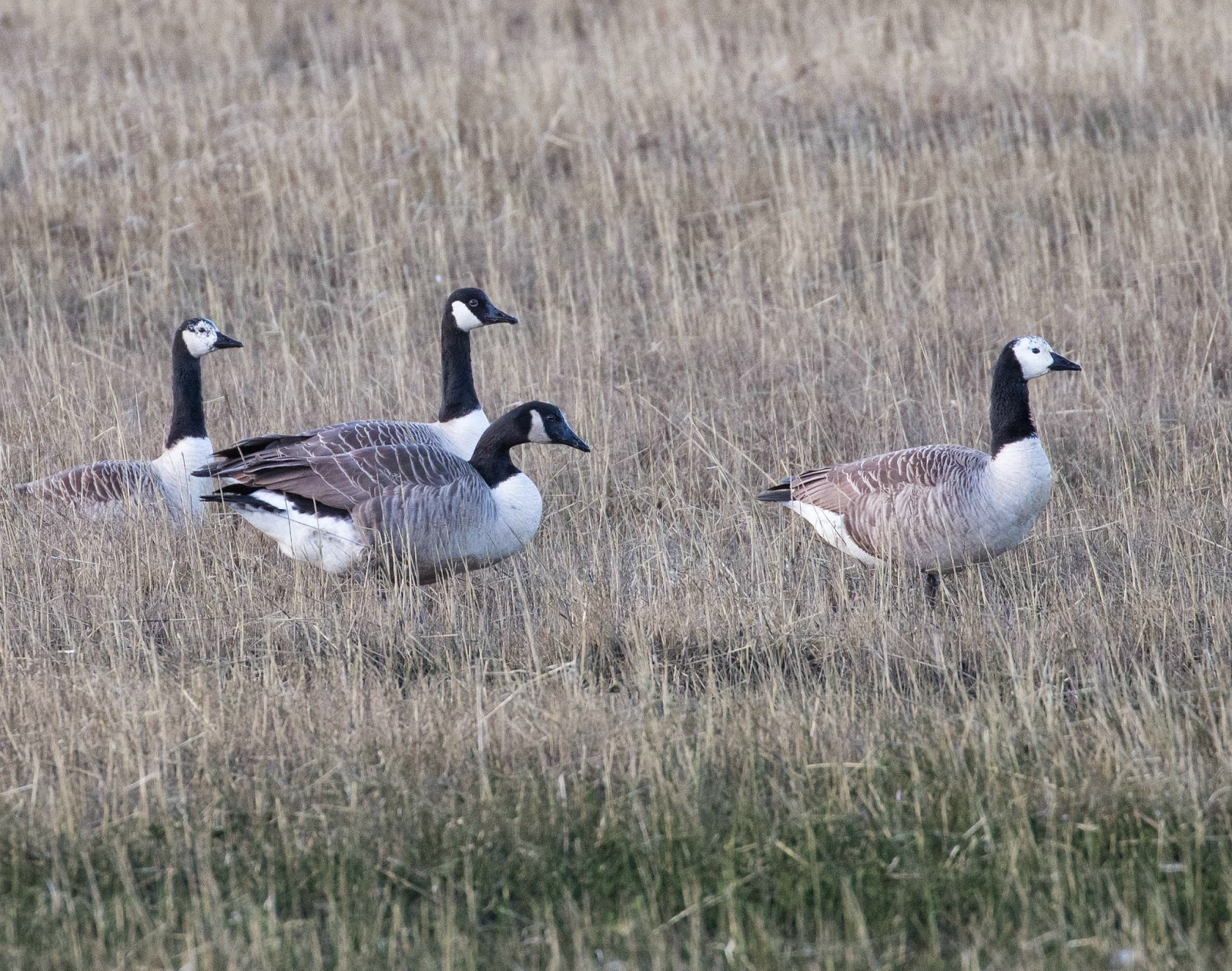
There were many Canada Geese on the saltmarsh including these two birds with extensive white on their foreheads.

A Peregrine kept harassing the birds at the site but it seemed to be for fun rather than with any real intent to capture prey.
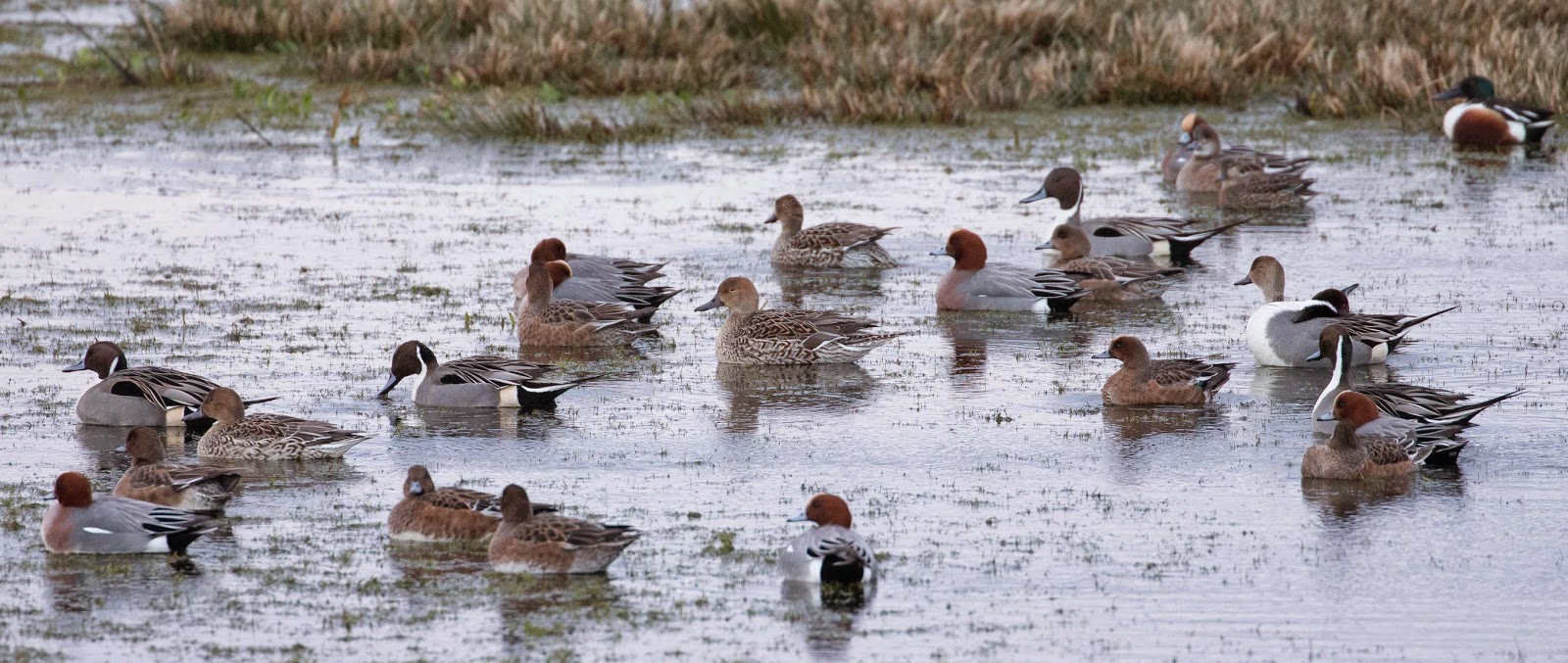
Mixed flock of Wigeon, Pintail and Shoveler on the floods at Pennington Marsh.

Buzzard with full crop flew low over Pennington Marsh putting up many of the birds


There were large numbers of Golden Plover on the floods at Pennington Marsh with around 500-700 birds. Unfortunately they were always in poor light and a little distant for decent photographs. There were also six Ruff amongst the gathered masses.

Tuesday, 27 January 2015

Extremadura - 19th January (Day 4 of 4)

The final day and up at 07:00 for a 07:30 breakfast, packed the bags and headed towards Embalse de Arrocampo in the dark. A short way from La Aldea del Obispo we passed over the  Rio Marinejo and in the half light I spotted an Otter swimming upstream towards the road, we slammed on the breaks, turned and drove back but by the time we got back there was no sign, I wound down the window and heard the characteristic whistle of an Otter but we could not see it. We headed of to Arrocampo where a patchy fog hung over the ponds and wet fields. We first went to hide 2 and waited for the sun to rise, in the 45 minutes we spent here birds seen included Purple Gallinule, Bluethroat, Water Pipit and a heard only Penduline Tit. The view was quite spectacular with the snow covered Sierra de Gredos Mountains in the distance but rather unsightly factories and pylons in the foreground. We headed off to an area of fields and scattered Holm Oak where Black-winged Kite occurs but after 1.5 hours driving this area we had no luck, highlight was stunning views of a male Penduline Tit which showed down to 5m or so. Other birds here included Green Sandpiper and the usual field species such as Spotless Starling, Crested Lark, Corn Bunting, White Stork, Zitting CisticolaCattle Egret and Iberian (Southern) Grey Shrike. We decided to head for hide 5 where Bittern had recently been seen and Ricardo had also seen Black-winged Kite and as we approached the hide the in front of us hovering was a stunning Black-winged Kite, the bird hovered and then flew a wide circle around us before disappearing into the distance. A short watch at hide 5 produced the usual range of common wetland birds and then it was time to head for the airport. The final bird of the trip as we drove into Madrid was Monk Parakeet. I checked in for my 15:45 flight and relaxed in the airport lounge for a couple of hours and tallied the trip list, a total of 117 species and four lifers - Great Bustard, Spanish Imperial Eagle, Iberian Green Woodpecker and Iberian Azure-winged Magpie.


Spotless Starling, a singing bird at Embalse de Aracampo


Spotless Starling at Embalse de Aracampo


Cattle Egret at Embalse de Aracampo


Corn Bunting at Embalse de Aracampo


White Stork at Embalse de Aracampo


Male Penduline Tit at Embalse de Aracampo 


Male Penduline Tit at Embalse de Aracampo


Black-winged Kite at Embalse de Aracampo


Crested Lark at Embalse de Aracampo


Zitting Cisticola at Embalse de Aracampo

Here are the links to the other days of the trip:

Monday, 26 January 2015

Extremadura - 18th January (Day 3 of 4)

We awoke at 06:30 to rain as was forecast despite the doubts we had of the accuracy of the forecast of rain the evening before. After a quick breakfast we headed out and drove north back through Monfrague National Park to Navaconcejo where we stopped at the Rio Jerte for Dipper here in Extremadura of the race 'aquaticus'. After a bit of scanning we eventually picked up a bird feeding on rocks in the middle of the river, after driving parallel with the river a short way we eventually got good views as it sang and fed in the middle of the river although it was still a little dark and murky for a decent photograph. We then headed up over the pass through the Tras la Sierra (Extremaduran Gredos) towards the pass at Puerto de Honduras where Ricardo had a site for our main target, Iberian Green Woodpecker and also for Citril Finch, but as we climbed the snow became thicker until we decided that the road was not going to be passable so after reversing some distance back down the road as it was too narrow to turn we headed back through Navaconcejo and took the lower pass via Puerto de Cabezabellosa. We then drove up the highway to the forest at Hervas where eventually after almost three hours on the road we reached our destination. We parked at the end of a rough track and walked through the very English like landscape consisting of small pastures and woodland blocks. The woodland here was dominated by ash, poplar and oak and it was not long before we heard the familiar yet noticeably high pitched 'yaffle' call of Iberian Green Woodpecker. After much scanning and playback I eventually picked the bird up rather distantly feeding on the ground, it looked fairly similar to 'our' Green Woodpecker but with less black on the face, and seemingly more green washed underparts. We tried to get closer views but to no avail. Other birds here were Nuthatch, Cirl Bunting, Iberian Azure-winged Magpie, Rock Bunting, Long-tailed Tit of the race 'irbii' and Serin.

Dipper of the race 'aquaticus', one of the black-bellied races at Navaconcejo
Snow bound road on way to pass at Puerto de Honduras
Habitat at Hervas. Iberian Green Woodpecker was the target here and was seen foraging in the meadow and calling from the ivy clad Poplars at the left side of this image.
Long-tailed Tit of the race 'irbii' with grey rather than pinkish scapulars at Hervas
Male Cirl Bunting at Hervas

We then headed back south on the E-803 highway but cut off at La Granja and passed through Tierras de Granadilla. This was an area of arable fields and holm oak studded pasture which we simply drove through with occasional stops but which yielded several hundred Common Crane, many White Stork, a roost of nine Stone Curlew, Thekla Lark and many of the other now familiar roadside birds. 

Flock of Common Crane at Tierras de Granadilla
Common Crane at Tierras de Granadilla
A stop at a pool at Fresnedillas produced several Crag Martin, Wigeon, 
Shoveler and Great White Egret
Thekla Lark at Tierra de Granadilla
White Stork were by now a familiar site nesting on a range of elevated structures

We then headed for the rice fields at El Batan. This rather unattractive area, consisting of flooded fields used for rice production and seemingly derelict factory farm buildings, was nonetheless very birdy. Our first stop at a flooded rice field pool produced Ruff, Greenshank, many Snipe, Green Sandpiper and a Lesser Yellowlegs which showed well and has been present since November. A Bluethroat showed very well as it worked a feeding circuit around the pool and eventually approached to within 10m or so. A Water Pipit also gave similarly excellent views. We spent the rest of the day birding this area seeing many hundreds of White Stork, Sardinian WarblerDartford WarblerZitting Cisticola, Hen Harrier, Little Owl, another Bluethroat, Hoopoe, many Spanish Sparrow and small flocks of introduced Red Avadavat and Common Waxbill


Lesser Yellowlegs at El Batan. This adult bird has been present since November 2014
Green Sandpiper at El Batan
Bluethroat at El Batan
Little Egret at El Batan
Water Pipit at El Batan
White Wagtail at El Batan
Common Waxbill at El Batan. A flock of around 20 of these smart introduced birds was present
Red Avadavat at El Batan
Male Stonechat at El Batan
Spanish Sparrow at El Batan. This is an abundant species in Extremadura
Part of a flock of around 300 White Stork at El Batan
Little Owl at El Batan
Hoopoe at El Batan


We finished the day at the rocks of Salto del Gitano in Monfrague National Park where we watched the Griffon Vultures spiralling round the cliffs and watched large flocks of Wood Pigeon pass over head to roost. We waited until after dark when, just at the last embers of light, we heard the distinctive 'whoo' of an Eagle Owl, somehow, Richardo managed to pick the bird out sitting right at the very top of Pena Falcon and through the scope the ear tufts were just visible in the darkness and at considerable distance. We headed back to the accommodation for 19:30 after another full and productive day in the field.


These are the rocks at Salto del Gitano in the Monfrague National Park. Amazingly, Ricardo picked out an Eagle Owl in near darkness at the very top of Pena Falcon, the middle peak of rocks. The birds flying around this cliff face are Grffon Vulture
Flocks of Wood Pigeon are always an impressive site

Here are the links to the other days of the trip: