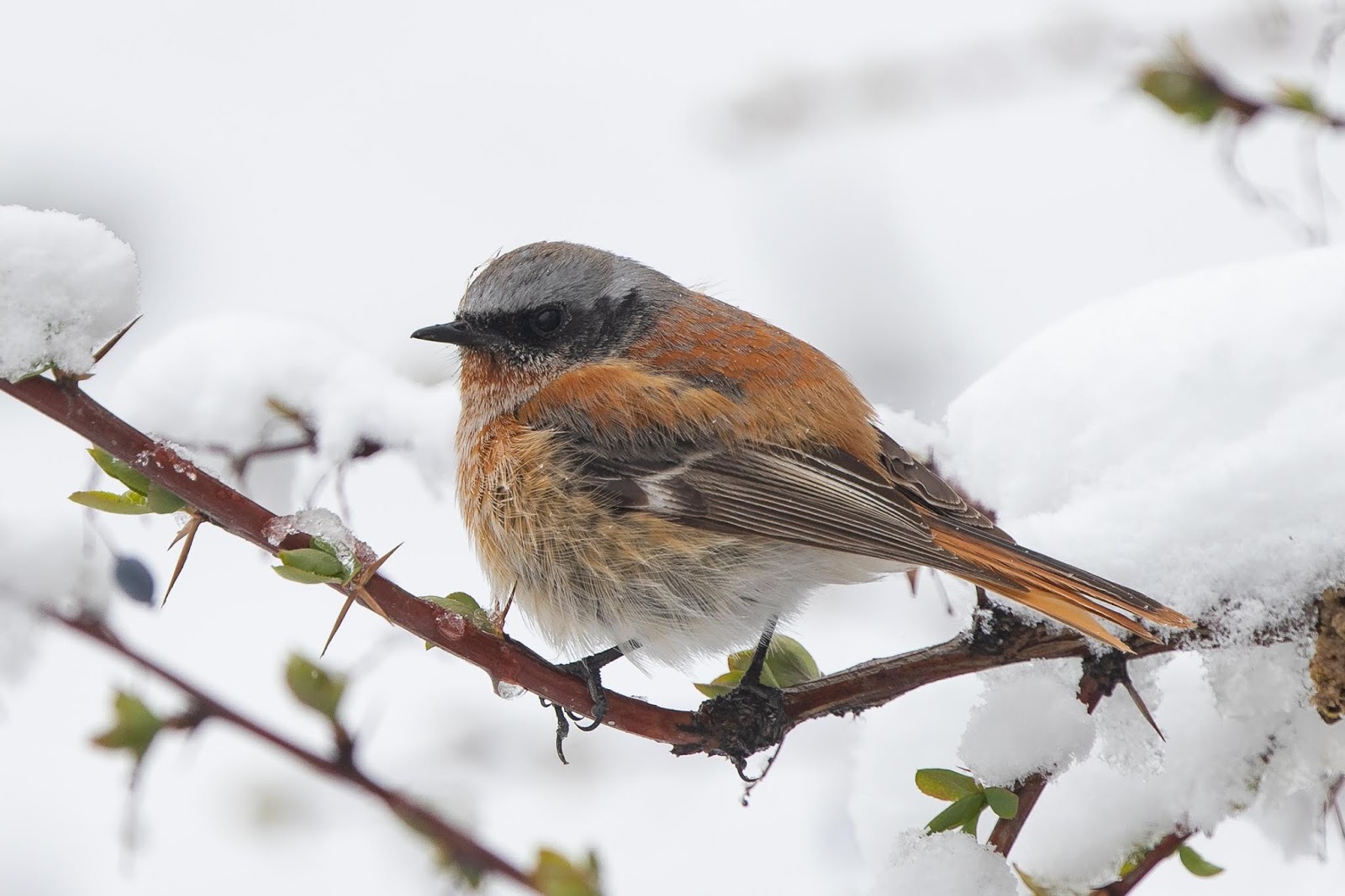
Awaking at 05:30 on 7th May I looked out of the hotel window to a scene of torrential rain, flooding and high winds. This did not bode well for our only day to Nanshan in the Tien Shan mountains – our only day here and my last day of the trip. Loading the bus at 06:00 we headed south from the city into the foothills and the rain turned to snow and as we approached our first birding site at around 1,500m this snow had reached near blizzard conditions. Our first target was Red-headed Bunting and I had seen images of this bird singing at this site in alpine meadows in beautiful sunny conditions – the weather we faced was a different kettle of fish altogether. Hopping out of the bus we were blasted by snow and a cold wind and optics quickly fogged. We birded this stretch of road for around an hour seeing small groups of finches and pipits moving south evidently trying to escape the conditions. Unperturbed were singing
Sky Lark plus
Water Pipit,
Richard’s Pipit,
Tawny Pipit and
Northern Wheatear but I dipped the only tick that the group saw, a pair of Red-fronted Serin. We decided that the conditions were too grim to bird so retired to the bus for breakfast – the usual fair of bread and sweet coffee – before heading to a different area to bird. Passing along a minor road flocks of birds were in abundance but we didn’t really stop as we were heading to a key birding area. We did stop for a flock of
Plain Mountain-finch beside the road and saw species such as
Mistle Thrush and a possible Black-throated Thrush from the bus. Arriving at the main site some 30 minutes later conditions were so bad that we didn’t even get out of the bus to walk the trail and decided to leave for a slightly lower and more sheltered elevation. As we descended Barry spotted a redstart from the bus which he swiftly identified as an Eversmann’s Redstart, one of our key targets, but we could not relocate it after we had disembarked the bus. Driving further down the road I spotted another redstart from the bus we stopped and all piled out and there was a stunning male
Blue-capped Redstart and then a male
Eversmann’s Redstart quickly followed by a
Black-throated Accentor all in the same clump of trees – three of our key tragets within a few minutes were seen. It soon became apparent that there were multiple birds of these species in a stretch of road of approximately 50m, these birds are normally higher in the woodlands at the site and far more difficult to see and it was clear that these birds had dropped to avoid the snow. We birded up and down the road and the numbers of these birds was incredible with 50+ of each being seen, at one point I watched 12
Black-throated Accentor feeding on the road together – Tang Jun says he normally only sees one or two of this species at the site and often struggles to see the two Redstart species. Along the road and passing overhead were also numerous
Water Pipit, Tree Pipit and
Godlewski’s Bunting while the bushes also held
Hume’s Warbler. It was difficult to tear ourselves away from the number of birds that the scrub aloing the road held but we still had two further targets. Having seen large numbers of birds along the roadside as we headed to this area we decided to descend further and birded a village area on the way back to the Red-headed Bunting site. This produced hundreds of
Pine Bunting around the village and in the fields with similar numbers of
Plain Mountain-finch. Also here we recorded
Red-tailed Rock-thrush,
Red-tailed Shrike,
Hoopoe,
Horned Lark,
Water Pipit,
Northern Wheater and
Common Stonechat of the subspecies
maura. It was evident that we had dropped out of the area where the redstarts and accentors were frequenting as we saw none of these species here. Another brief look for the Red-headed Bunting drew a blank and we decided that the birds had probably descended lower to escape the snow.
After an hours lunchstop I was itching to get back into the field and with only two hours left I still wanted to see two target species. So we headed back to the main birding site and stopped in a layby. Here there were multiple
Blue-capped Redstart,
Eversmann’s Redstart,
Black-throated Accentor and
Godlewski’s Bunting which we enjoyed but our remaining target birds were not here. We headed to the main car park area, and as we approached Tang-Jun spotted a
Red-mantled Rosefinch on the roadside so we leapt out of the car and quickly located two females and a male, as we watched these birds I heard a flock of serin calling and a scan produced a flock of around 25
Red-fronted Serin flying up the valley, fortunately they landed and we enjoyed reasonable, although a little distant views of these stunning little finches with their fire red foreheads. These were our two remaining targets and we had seen them within the space of a few minutes. Martin called a Rubythroat and I was amazed when I saw that it was a
Himalayan Rubythroat, another new bird in the space of a few minutes and one that was not on my radar to see. There were two of these stunning birds feeding in the roadside scrub and ditches and we enjoyed good views. I had an hour before my taxi arrived to take me back to Urumqi and so we birded this area seeing more
Eversmann’s Redstart,
Blue-fronted Redstart and
Black-throated Accentor - we were simply stunned at the number of birds present and it reminded me of a similar fall of birds that we experienced in Mongolia,
see here.
At 17:00 my taxi arrived and I said goodbye to Barry, Martin, Ian, Andy D, Andy B and Volkert and drove the short distance to the airport with my local driver. We dropped out of the snow zone into rain and I arrived at the airport at just gone 18:00 for my 21:15 flight to Beijing. The lady at the check in desk informed me that the 21:15 flight had been delayed and instead managed to get me onto the 19:15 flight and by 23:00 I was in Beijing. My bags took an age to arrive and it was almost midnight by the time I left the airport. I transferred to the Eastern Airline Hotel arriving at 00:45 and enjoyed a very plush apartment room while repacking ready for my international flight tomorrow, I eventually crashed at around 02:00.
Male Eversmann's Redstart - Nanshan, Tien Shan Mountains
Male Blue-capped Redstart - Nanshan, Tien Shan Mountains
Male Blue-capped Redstart - Nanshan, Tien Shan Mountains
Black-throated Accentor - Nanshan, Tien Shan Mountains
Pine Bunting - Nanshan, Tien Shan Mountains
Red-tailed Shrike - Nanshan, Tien Shan Mountains
Red-tailed Shrike - Nanshan, Tien Shan Mountains
Red-tailed Shrike - Nanshan, Tien Shan Mountains
Red-tailed Shrike (differenet bird to above) - Nanshan, Tien Shan Mountains
Eurasian Sparrowhawk - Nanshan, Tien Shan Mountains
Common Stonechat of subspecies maura - Nanshan, Tien Shan Mountains
Horned Lark of subspecies brandti - Nanshan, Tien Shan Mountains
Eurasian Hoopoe - Nanshan, Tien Shan Mountains
Rufous-tailed Rock-thrush - Nanshan, Tien Shan Mountains
Rufous-tailed Rock-thrush - Nanshan, Tien Shan Mountains
Isabelline Wheatear - Nanshan, Tien Shan Mountains
Godlewski's Bunting - Nanshan, Tien Shan Mountains
Black-throated Accentor - Nanshan, Tien Shan Mountains
Tree Pipit - Nanshan, Tien Shan Mountains
Red-mantled Rosefinch - Nanshan, Tien Shan Mountains
Eversmann's Redstart - Nanshan, Tien Shan Mountains
Himalayan Rubythroat - Nanshan, Tien Shan Mountains
Hamalayan Rubythroat - Nanshan, Tien Shan Mountains
Black-throated Accentor - Nanshan, Tien Shan Mountains
Black-throated Accentor - Nanshan, Tien Shan Mountains
Black Kite - Nanshan, Tien Shan Mountains
Andy B, Martin and Andy D enjoying the snow - Nanshan, Tien Shan Mountains
Nanshan, Tien Shan Mountains
Conditions were blizzard like
Leaving Nanshan and heading back to the aiport at Urumqi
Rather sterile city scape of the new Urumqi. Most of the older buildings are being flattened to make way for these apartment blocks across the city
After a short sleep I was up at 06:00 on the 8th May and after a quick repack I was on the shuttlebus from the Eastern Airline Hotel in Beijing to the International Airport. I checked in then relaxed after some duty free shopping. My flight was delayed and we eventually departed at 11:45, 30 minutes late. Flying north-west we passed over Xinjiang and I thought of the Ground-jay’s below and then over Ullan Bataar where I had visited a little later this time last year. We headed over Russia and the Baltic before landing at Heathrow 15:15.
List of Birds Recorded in the South-east and North-west China
We recorded 322 species 34 of which were ticks for me (shown in bold). Bird of the trip for me was Cabot's Tragopan with Reeve's Pheasant, Chinese Crested Tern, Xingjiang ground-jay, Siberian Thrush, Himalayan Rubythroat, Eversmann’s Redstart and Blue-capped Redstart being up there.
Collared Partridge
Chinese Bamboo-partridge
Cabot's Tragopan
Koklass Pheasant
Elliot's Pheasant
Reeves's Pheasant
Common Pheasant
Silver Pheasant
White-headed Duck
Ruddy Shelduck
Mandarin Duck
Red-crested Pochard
Common Pochard
Tufted Duck
Garganey
Northern Shoveler
Falcated Duck
Gadwall
Eurasian Wigeon
Chinese Spot-billed Duck
Mallard
Northern Pintail
Common Teal
Little Grebe
Great Crested Grebe
Black-necked Grebe
Rock Dove
Hill Pigeon
Stock Dove
Oriental Turtle-dove
Eurasian Collared-dove
Eastern Spotted Dove
Laughing Dove
Grey Nightjar
White-throated Needletail
Edible-nest Swiftlet
Pacific Swift
House Swift
Common Swift
Greater Coucal
Lesser Coucal
Western Koel
Large Hawk-cuckoo
Oriental Cuckoo
Brown Crake
White-breasted Waterhen
Common Moorhen
Common Coot
Eurasian Spoonbill
Black-faced Spoonbill
Asian Crested Ibis
Eurasian Bittern
Black-crowned Night-heron
Green-backed Heron
Chinese Pond-heron
Cattle Egret
Grey Heron
Great White Egret
Little Egret
Chinese Egret
Great Cormorant
Pied Avocet
Black-winged Stilt
Grey Plover
Pacific Golden Plover
Little Ringed Plover
Kentish Plover
White-faced Plover
Lesser Sandplover
Greater Sandplover
Grey-headed Lapwing
Whimbrel
Little Curlew
Eurasian Curlew
Far Eastern Curlew
Bar-tailed Godwit
Black-tailed Godwit
Ruddy Turnstone
Great Knot
Red Knot
Broad-billed Sandpiper
Sharp-tailed Sandpiper
Curlew Sandpiper
Long-toed Stint
Spoon-billed Sandpiper
Red-necked Stint
Sanderling
Dunlin
Asian Dowitcher
Common Snipe
Terek Sandpiper
Common Sandpiper
Green Sandpiper
Grey-tailed Tattler
Spotted Redshank
Common Greenshank
Common Redshank
Wood Sandpiper
Marsh Sandpiper
Saunders's Gull
Black-headed Gull
Black-tailed Gull
Lesser Black-backed Gull
Arctic Herring Gull
Little Tern
Common Gull-billed Tern
Caspian Tern
Whiskered Tern
White-winged Tern
Common Tern
Chinese Crested Tern
Greater Crested Tern
Northern Boobook
Collared Owlet
Little Owl
Oriental Scops-owl
Osprey
Black Baza
Black Eagle
Booted Eagle
Eastern Marsh-harrier
Crested Goshawk
Chinese Sparrowhawk
Eurasian Sparrowhawk
Black Kite
Grey-faced Buzzard
Eurasian Buzzard
Long-legged Buzzard
Red-headed Trogon
Common Hoopoe
Oriental Dollarbird
Common Kingfisher
Black-capped Kingfisher
Great Barbet
Eurasian Wryneck
Speckled Piculet
Grey-capped Woodpecker
Great Spotted Woodpecker
White-winged Woodpecker
Pied Falconet
Common Kestrel
Red-footed Falcon
Merlin
Peregrine Falcon
Black-naped Oriole
White-browed Shrike-babbler
White-bellied Erpornis
Grey-chinned Minivet
Scarlet Minivet
Ashy Minivet
Brown-rumped Minivet
Black-winged Cuckooshrike
Black Drongo
Ashy Drongo
Hair-crested Drongo
Brown Shrike
Red-tailed Shrike
Isabelline Shrike
Long-tailed Shrike
Grey Treepie
Red-billed Blue Magpie
Asian Azure-winged Magpie
Plain-crowned Jay
Xinjiang Ground-jay
Eurasian Magpie
Common Raven
Carrion Crow
Collared Crow
Large-billed Crow
Sultan Tit
Yellow-bellied Tit
Azure Tit
Great Tit
Yellow-cheeked Tit
Chinese Penduline-tit
Hume's Lark
Horned Lark
Eurasian Skylark
Oriental Skylark
Crested Lark
Bearded Reedling
Zitting Cisticola
Yellow-bellied Prinia
Plain Prinia
Common Tailorbird
Sykes's Warbler
Black-browed Reed-warbler
Oriental Reed-warbler
Marsh Grassbird
Red-rumped Swallow
Barn Swallow
Collared Sand Martin
Chestnut Bulbul
Mountain Bulbul
Black Bulbul
Collared Finchbill
Red-whiskered Bulbul
Brown-breasted Bulbul
Light-vented Bulbul
Yellow-browed Warbler
Hume's Leaf-warbler
Pallas's Leaf-warbler
Dusky Warbler
White-spectacled Warbler
Alström's Warbler
Eastern Crowned Warbler
Chestnut-crowned Warbler
Pale-legged Leaf-warbler
Sakkalin Leaf-warbler
Hartert's Leaf-warbler
Rufous-faced Warbler
Brownish-flanked Bush-warbler
Korean Bush-warbler
Black-throated Tit
Silver-throated Tit
Lesser Whitethroat
Tarim Hill-warbler
Reed Parrotbill
Grey-headed Parrotbill
Short-tailed Parrotbill
Vinous-throated Parrotbill
Indochinese Yuhina
Black-chinned Yuhina
Japanese White-eye
Streak-breasted Scimitar-babbler
Grey-sided Scimitar-babbler
Rufous-capped Babbler
Dusky Fulvetta
Grey-cheeked Fulvetta
Chinese Hwamei
Lesser Necklaced Laughingthrush
Grey Laughingthrush
White-browed Laughingthrush
Masked Laughingthrush
Black-throated Laughingthrush
Blue-crowned Laughingthrush
Brown Dipper
Common Starling
Purple-backed Starling
Black-collared Starling
White-shouldered Starling
Red-billed Starling
White-cheeked Starling
Crested Myna
White's Thrush
Siberian Thrush
Chinese Thrush
Mistle Thrush
Eurasian Blackbird
Chinese Blackbird
Japanese Thrush
Grey-backed Thrush
Pale Thrush
Dusky Thrush
Black-throated Thrush
Oriental Magpie-robin
Grey-streaked Flycatcher
Asian Brown Flycatcher
Small Niltava
Zappey's Flycatcher
Blue-and-white Flycatcher
Siberian Blue Robin
Rufous-tailed Robin
Bluethroat
Siberian Rubythroat
Himalayan Rubythroat
White-crowned Forktail
Spotted Forktail
Blue Whistling-thrush
Yellow-rumped Flycatcher
Green-backed Flycatcher
Narcissus Flycatcher
Mugimaki Flycatcher
Eversmann’s Redstart
Blue-capped Redstart
Plumbeous Water-redstart
Daurian Redstart
Chestnut-bellied Rock-thrush
Rufous-tailed Rock-thrush
Common Stonechat
Northern Wheatear
Desert Wheatear
Spotted Elachura
Fork-tailed Sunbird
Black-throated Accentor
White-rumped Munia
Scaly-breasted Munia
Saxaul Sparrow
House Sparrow
Russet Sparrow
Eurasian Tree Sparrow
Pechora Pipit
Tree Pipit
Olive-backed Pipit
Water Pipit
Richard's Pipit
Tawny Pipit
Grey Wagtail
Citrine Wagtail
Eastern Yellow Wagtail
White Wagtail
Chinese Grosbeak
Red-mantled Rosefinch
Plain Mountain-finch
Desert Finch
European Greenfinch
Oriental Greenfinch
Common Linnet
Red Crossbill
Red-fronted Serin
Eurasian Siskin
Chestnut-eared Bunting
Godlewski's Bunting
Pine Bunting
Ochre-rumped Bunting
Pallas’s Bunting
Yellow-breasted Bunting
Little Bunting
Black-faced Bunting
Yellow-browed Bunting
Tristram’s Bunting
Links to Other Days of the Trip (Click to View)
Day 1 and 2 – International flight and Dongtai.
Day 3 - Dongtai.
Day 4 – Dongtai and Magic Wood.
Day 5 - Nanhui then fly to Fuzhou.
Day 6 - Shanutan Island and Fuzhou Forest Park.
Day 7 - Fuzhou Forest Park then Emeifeng Mountain.
Day 8 - Emeifeng Mountain.
Day 9 - Emeifeng Mountain.
Day 10 - Emeifeng Mountain then Wuyuan.
Day 11 - Wuyuan.
Day 12 – Drive Wuyuan to Dongzhai.
Day 13 - Dongzhai.
Day 14 – Dongzhai then fly Wuhan to Korlor.
Day 15 – Taklamakan Desert.
Day 16 – Taklamakan Desert then Urumqi.