Thursday, 27 November 2014

October 2014 Rarities

Introduction
This is my summary of what I consider to be the most exciting records from the UK in October 2014, this is not aimed at being a comprehensive account of all the rare's in the UK in this month, for such accounts see the Birdguides review of the week or the Rare Bird Alert weekly round-up. I am largely writing this as a personal record of UK records and sightings to aid my knowledge and feed my interest in UK bird records. I aim to publish the previous months records in the first week or so of the following month. The photographs that I used have been gleaned from the internet, I aim to provide the photographer with full credit and a link to their website or blog, if you see that one of yours has been used and you object to this then please email me and I will remove it immediately, alternatively if you would like to supply a better image or additional information or links then I will add. Contact me at simon@ecosa.co.uk

Weather
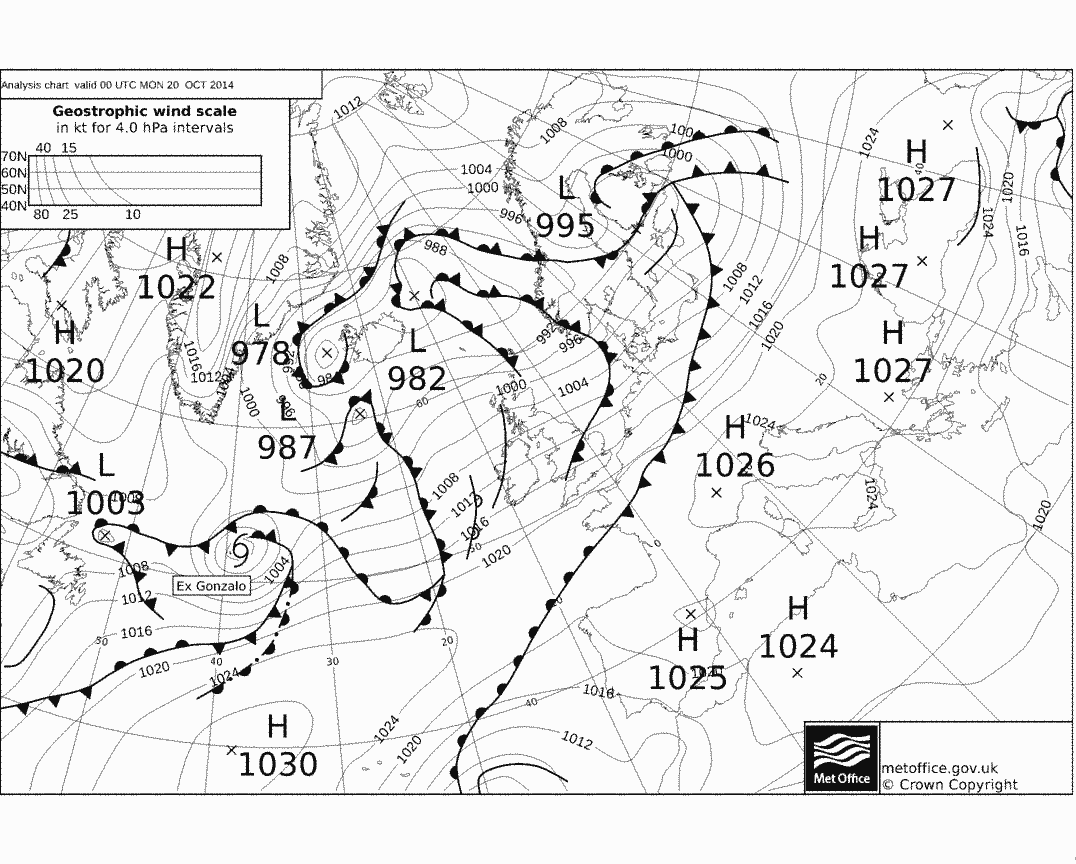
A summary of the weather for October 2014 can be found here.

October 2014
October is the traditional month for rarity's in Britain and never ends the debate on which location will perform best, will it be the Isles of Scilly, Shetland or the East Coast. With every October expletives rain amongst the birding community with each October seeming to surpass the last with ever more extreme rarities. So October passed with a mix of Asian and American megas with Hurricane Gonzalo making landfall on 21st October giving a final flurry of western megas to the month, see my write-up of this event here.

The Masked Shrike from September lingered until the 3rd October, taking its place as mega of the moment was a stunning Siberian Rubythroat at Levenwick found on the afternoon of the 3rd. The bird showed well on a driveway, often being scolded by Robin's. This was a stunning first winter male and while the 9th UK record it attracted a steady trickle of admirers and will no doubt be the top of many birders 'highlight of the year' list. The bird stayed until the 8th October when it disappeared overnight.

Siberian Rubythroat - Levenwick, Mainland Shetland - Simon Colenutt


A stunning and very confiding Steppe Grey Shrike at Burnham Norton, Norfolk from 5th to 16th October was a first for the county and very popular as a result.

Mike Weedon's fantastic image of the Steppe Grey Shrike at Burnham Norton, See more of Mike's great images on his blog, Weedon's World of nature here


Also on 5th a Blyth's Pipit was on St. Mary's Isles of Scilly where it frequented the airport runway and adjacent fields. the bird lingered until 15th and was perhaps the highlight of a slow autumn on Scilly.

Blyth's Pipit on St. Mary's, Isles of Scilly by Simon Knight. Simon's fantastic gallery of images can be viewed on his website at Simon Knight Photography here


It was again the Scottish Islands coming up trumps on the 6th October when a Scarlet Tanager, the 10th British record if accepted, was found in a Sycamore stand on Barra, Outer Hebrides and lingered until the 9th October.

Scarlet Tanager Barra - A great image by John Kemp really capturing the birds character amongst autumnal Sycamore leaves


A Bonelli's Warbler found in gardens at Scalloway, Shetland on 10th remained until 13th October was eventually identified as an Eastern Bonelli's Warbler after it called on the second day of its stay.

A second winter Audouin's Gull was a short stayer on 12th October at Dungeness, Kent. Images on Michael Southcott's Blog 'Birding the Day Away'.

It was a brave and experienced birder that called a fly-by Brunnich's Guillemot at Flamborough Head, East Yorkshire on 13th October. A write-up of the observation can be read on the 'Birding Frontiers' blog. This to me is a very convincing account and it will be interesting to see if this bird is accepted by BBRC - surely this often hard to identify species is more frequent than is currently known in UK waters.

A Siberian Thrush trapped at Scousburgh, Shetland on 15th October was an amazing record although was seen only by a fortunate few who were able to get to site that evening. The bird was nowhere to be seen the following day. Amazingly the bird had been ringed in Norway on 24th September (images here). It would be fascinating to know where this bird had been in the interim and where its trajectory lead it, did it disappear into the North Atlantic or did it re-orientate and head south or back east?

Classic image of the Siberian Thrush at Scousburgh, mainland Shetland by Roger Riddington


At the end of the month Hurricane Gonzalo struck the uk providing a scatter of mega American birds across the UK from SW Cornwall to North Ronaldsay with the highlights being:

  • Hermit Thrush Balranald RSPB, Outer Hebrides 22nd-23rd October. Read the Birdguides rarity finders article here
  • Black-billed Cuckoo North Ronaldsay, Orkney 23rd October
  • Yellow-billed Cuckoo Porthgwarra, Cornwall 23rd-24th October
  • Chimney Swift Lewis, Outer Hebrides 23rd-24th October. Read the Birdguides rarity finders article here


Yellow-billed Cuckoo at Porthgwarra by Pete Morris


And then finally on the 30th October the third Eastern Crowned Warbler for the UK was found on 30th October at Brotton, Cleveland, the bird lingering until 1st November. The first record of the species was in 2009 and one hopes that the next record will be further south to give those less inclined to drive long distances to the north to see this mega long distant migrant. The Birdguides rariety finders article can be viewed here.

Eastern Crowned Warbler Brotton, Cleveland 30th October- 1st November. Photo by Gary Thoburn, see more of Gary's fantastic Eastern Crowned Warbler shots here and read his blog, here

So onto November, traditionally a quite month after frenetic October but often with a great mega thrown in............


Previous Monthly Accounts Can be viewed here:

Monday, 17 November 2014

Isabelline Shrike Hengistbury Head - 16th November 2014

News broke of an Isabelline Shrike yesterday afternoon at Hengistbury Head but I was committed to an afternoon at Beaulieu Motor Museum with Sarah and Tobias so I hatched a plan to get up early and get home before another planned social event at midday. I awoke once more to heavy rain but decided that a  British tick 30 minutes down the road was too much of a temptation to blow-out. I arrived on site in the wet gloom at 07:30 and almost immediately bumped into a female Black Redstart at the Hikers Cafe. I headed out to the area of Wick Fields where the bird had been seen yesterday and joined the 10 or 15 birders present. My first views of the bird were frustrating with glimpses of a pallid head and lightly chevroned flanks through the bushes as the bird appeared to have just emerged from its roost. After standing in the rain for a further 30 minutes chatting to an old friend and colleague Jeff Picksley the bird made a break for it northwards along the hedge line so I relocated from the east to the west side of the hedgerow hoping the bird would hop up into slightly better light. After 15 minutes or so it appeared and sat low on the hedgerow shaking off the rain - it was a miserable wet morning and the British weather must have been a bit of a shock to its system, it certainly was for mine. I got a few snaps of it before it disappeared once more. Rarer still was the site of a great friend Andy Butler from the Isle of Wight accompanied by mega year lister and Island birder Pete Cambell. Andy has not birded off the island for 20 years while Pete is well on his way to 300 species for the year. We enjoyed a bit of banter before I had to head off for another social event, I felt a few glasses were deserved even though I wanted to stay in the field.


Calshot Spit and Lepe Country Park - 14th November 2014

Trevor Codlin and I headed out for a mornings birding at Calshot Spit and Lepe Country Park (Trev's pictures and account can be seen here). The day started very wet and we were tempted to sleep off the hangovers but we headed out as the rain eased leaving our wifes at home to catch up on gossip. We started at Calshot Spit where a very confiding Snow Bunting had been present until Wednesday 12th at least, we were convinced it would still be present but despite checking all the weedy patches there was no sign of it. Still, in the now pleasantly warm conditions we enjoyed good views of waders in the bay to the north of the spit with around 250 Dunlin, 75 Oystercatcher and many Redshank - most of which seemed to be dozing on the low tide when I would have thought they should have been feeding. Also present were approximately 50 Turnstone and small numbers of Grey Plover, Ringed Plover, Black-tailed Godwit and Curlew. A Little Egret chased small fish or possibly shrimp through the shallows while another five or six birds were present nearby. Offshore there were 18 Great Crested Grebe and a fine Grey Seal which surfaced several times close to shore as it moved rather rapidly east.

Dunlin -  One or two bird still showed traces of juvenile or summer plumage but this bird appears 
to be fully moulted

Little Egret - Erratically foraging in the shallows

Redshank - Dozing on the low tide

A small flock of Black-headed Gull had gathered in the bay to the north of the spit. At least three of the 28 birds had been ringed and Trev and I spent a bit of time trying to read the ring numbers but beyond one bird with a partial number of E474 we could not get any combinations. The flock was joined by a fine adult Mediterranean Gull and we settled to watch it preen for a while. Breakfast was calling so we headed to the cafe at Lepe Country Park.

Mediterranean Gull - Adult winter

Black-headed Gull - In a nice wing stretching pose

After our full English we birded the small copse to the west of the main car park and spent a little time in the hide. A Firecrest was seen all to briefly while a pair of Bullfinch showed well, the male heard in song and seen bathing in a pool on the woodland floor. Otherwise it was remarkably quiet, a handful of Redwing and a fleeting glimpse of a Cetti's Warbler. It was time to go home.

Tuesday, 4 November 2014

Moths, Blashford Lake and the close of October

Its been a bit of a 'bits and pieces' time for me recently with no real time for birding and the grey and wet conditions generally coinciding with any time I had off to go birding. I did run the moth trap in the garden on the nights of 27th, 28th and 29th October. Numbers of moths were not high but i did catch a couple of stunning Merveille du Jour, two White-point, two Udea ferigalis and a stunning fresh Slender Burnished-brass amongst the more usual species for the time of year.

Merveille du Jour

Slender Burnished-brass

White-point

Angle-shades

Blair's Shoulder-knot

Green Brindled Crescent

Red-green Carpet

On 2nd November I paid a rare visit to Blashford Lakes. This is a site that is only 20 minutes from home yet one that, for some reason, doesn't massively inspire me. Granted, it gets some good birds but I always feel a bit hemmed in by the 09:00 opening time, the birding from the hides and the often rather distant views of birds. I partly visited today as a Franklin's Gull has been coming into roost on Ibsley Water late in the evening since 28th October having been first seen during the day on the 19th and I had the intention of sussing out the hide before a late afternoon visit. The bird has been showing from the Tern Hide and the Lapwing Hide overlooking Ibsley Water. The latter giving closer views but the former better light. As has been the trend on my last few birding outings the weather was pretty grey and miserable. I arrived at Blashford Lake at 07:30 in torrential rain - bugger, I had forgotten that I couldn't get anywhere until 09:00 so I drove to Ocknell Plain in the New Forest and birded Slufter's Enclosure seeing little but for 10 Fieldfare, 50 Redwing and an impressive flock of around 250 Chaffinch.

Back to Blashford and I wandered up to the Lapwing Hide where, unsurprisingly, everything seemed miles away. Plenty of Pochard, Tufted Duck, Great Crested Grebe, Little Grebe, Teal and Wigeon. Four non-breeding plumage Ruddy Duck were the first I had seen for a while. I wandered back and the Great White Egret showed distantly on Mockbeggar Lake disappearing before I could set my camera up and a few Chiffchaff called from the willows. I entered Goosander Hide and there, at last were some close birds, Cormorants! Two Goosander, a Black-necked Grebe and six Egyptian Goose kept their distance.

Great-crested Grebe from Lapwing Hide

Black-necked Grebe from Goosander Hide

Little Grebe from Lapwing Hide

Cormorant from Goosander Hide

Cormorant from Goosander Hide

Pochard from Goosander Hide

Non-breeding male Ruddy Duck from Lapwing Hide

On the 3rd November I arrived at the Tern hide at 15:00 having thoughts of being the first or second there for the Franklin's Gull but nope - packed hide and standing space only. I shuffled around and took my position at the back pointing my scope through the heads to focus on the area of water that I had been told the bird usually alights on.  I scanned around distant Great Northern Diver, distant Gulls, a few Lesser Black-back and at least two adult Yellow-legged Gull, a distant Black-necked Grebe and an assortment of distant wildfowl. I stood, checked my watch - only 1.5 hours to go before any chance of the gull arriving. My standing height meant all that I could see was the wood of the hide - great! So I adopted a hunched position and scanned the water for almost the full duration without lifting my head. Gulls started to pour in by 16:00 and there were many Lesser Black-backs and Black-headed Gull but curiously few Common or Herring Gull. And then the shout went out at 16:40 - there it is to the right of the yellow and red buoy, behind the Canada Geese midway to the willow bush, I scanned and searched and there it was, a black head amongst the mainly white headed gulls. Bloody hell, it was distant and in fading light. Still, I studied the salient features - dark mantle, white clown eye ring, prominent white tertial crescent - nice. I was amazed that people had spent 2 hours in the hide and got up and left after watching the bird for 10 minutes! I stayed put until the light faded and the hide was locked.

A selection of distant gulls - mainly Lesser Black-backs and Black-headed Gull

Franklin's Gull - Just in front of the central Lesser Black-back.

Tuesday, 28 October 2014

Pennington Marsh and Needs Ore Point- 25th October

The morning was forecast to be sunny and with a hope of getting some nice photos I set off with my camera to Pennington Marsh but it was grey and drab with a gentle westerly breeze so I settled for my scope and Sony RX100 for a bit of digiscoping and some crap photos. It was remarkably slow going on the marshes and I walked south from the Lower Pennington Lane car park out past the Shoveler Pools, along to Keyhaven Lagoon and then back around Fishtail and Butts Lagoon. The tide was on the rise and not far off high and the water levels in the lagoons were high.

A single Chiffchaff called in the scrub next to the car park and around five Goldcrest quickly moved through. On Efford Lagoon there were around 55 Wigeon and 35 Coot. An immature male Peregrine passed through and landed on the north side of the lagoon flushing at least 75 Meadow Pipit from the recently seeded ground. As I headed past Shoveler Pool there were six stonechat on the The Old Tip, a higher number than usual and possibly indicating some migrants had arrived. There was a good gathering of Brent Goose on Fishtail Lagoon with around 175 birds present. These birds had gathered to bath and preen but there was a great deal of squabbling amongst the family groups as they maintained their personal space.

A family group of Brent Goose defend their personal space

The difference in structure between this pair of Brent Goose is evident with the male clearly with a bulkier head and bill, it was also substantially larger.

Out on the mudflats there was very little mud exposed and most of the wildfowl were loafing on the margins and the waders were roosting. 

Adult male Wigeon approaching the end of its moult from eclipse plumage still with much chestnut feathering inn the flank and breast and with subdued head colours.

Adult female Wigeon

On Keyhaven Lagoon there were around 250 Wigeon and with good numbers of Shoveler now present, a total of 95 being counted. There was a distinctly wintery feel to the birding.

Shoveler on Keyhaven Lagoon

Continuing on my little mission of photographing and getting to know gull plumages a bit better I was hoping for a selection of gulls on Efford Lagoon but there were but a handful of Black-headed Gulls. Out on the mudflats there were half a dozen Common Gull, 25 very distant Herring Gull and half a dozen distant Great Black-backed Gulls all of which were adult but for this 2nd winter bird - mega distant!

Adult winter Common Gull. Moult to winter plumage is complete and extends from August and is completed in October. 

2nd winter Great Black-backed Gull. Again winter plumage is achieved through a complete moult through the summer and completing in October. While I am no expert, this bird looks to be fairly advanced to me for this age with perhaps more of the dark of the adult feathers in the mantle and wings than is the norm for this age group.

AFter an uneventful few hours at Pennington I then spent a couple of even less eventful hours at Needs Ore Point having recently obtained a new permit. It was very slow going though with the only birds of any note being a Chiffchaff, Cetti's warbler and around 250 Brent Goose at the mouth of the Beaulieu River. The tide was very high and I pushed off home.

Monday, 27 October 2014

Hurricane Gonzalo - 21st October 2014

Hurricane Gonzalo was a powerful hurricane that tracked through the Caribean and across the North Atlantic to make landfall on UK soils on 21st October. This was the first major ex-hurricane to make landfall in Autumn 2014 and there was a great air of expectation as to which American species it might deliver and where these would occur, the obvious sites being Shetland, Ireland and the Isles of Scilly.

The track of Gonzalo as it passed through the Caribbean and towards the UK
Position of Gonzalo on 20th October
Gonzalo makes landfall on 21st October

The first bird to be found and likely to have been deposited by Gonzalo was a Hermit Thrush found at Balranald, North Uist on 22nd October but 23rd was the day when it all happened producing an outstanding list of North American passerines in the UK on just one day. The Scottish Islands took the lions share with nothing on that former American mega of the Isles of Scilly and nothing from the rather underwatched west coast of Ireland. The list:

  • Hermit Thrush - 22nd-23rd October at Balranald RSPB, North Uist
  • Grey-cheeked Thrush - 23rd October on Barra, Outer Hebrides
  • Grey-cheeked Thrush - 23rd October on North Ronaldsay, Orkney 
  • Yellow-billed Cuckoo - 23rd and 24th October at Porthgwarra, Cornwall
  • Black-billed Cuckoo - 23rd October on North Ronaldsay, Orkney
  • Chimney Swift - 23rd to 25th October on Lewis, Outer Hebrides
  • Grey-cheeked Thrush - 24th and 25th October on Fair Isle, Shetland

Thursday, 23 October 2014

Pennington and Keyhaven Marshes and Titchfield Haven - 19th and 20th October

After the excitement of the last few weeks I was back on the local patch at Keyhaven and Pennington Marshes on 19th October walking the usual route. It was a fairly slow morning, the tide was high and the lagoons appeared very full of water so waders were a little hard to come by and there were few passerines to be seen. Highlights were five Chiffchaff and a similar number of Goldcrest three or four Bearded Tit, pinging in the Lower Avon Marsh reed beds, 150 Brent Goose, six Greenshank and 120 Black-tailed Godwit on Keyhaven Lagoon and 21 Coot on the Efford Lagoon. There was some viz mig with small numbers of Goldfinch, Linnet and Meadow Pipit moving west into the westerly wind. The Efford Lagoon is really starting to come into its own with a high count of Coot today, 75 Lapwing, 55 Oystercatcher and good numbers of gull loafing on the banks. I don't get to study many gulls in general and consider them to be a group that I somewhat neglected so this winter I am determined to start to get to grips with them and possibly, if the enthusiasm takes me, start a separate page on this blog showing the various age stages of the commonly encountered species. for now, I have taken shots of the range of Herring gull present today at Efford Lagoon - when I say there were good numbers, I am talking 20 birds and not the vast numbers encountered on many sites - give Efford time though and I think that a big roost will form.

On Monday 20th October, I was working nearby and popped into Titchfield Haven Nature Reserve to take a look at the Siberian Stonechat that has been present since 18th October. The bird was present in front of the Meadow Hide on the eastern side of the reserve and was feeding within an area of recently cut reeds and sedges. It showed well if a little distantly for the 20 or so gathered birders. Always too distant for the SLR I only managed distant digi-scoped shots. There were also around 12 Common Stonechat present and the recent reed cutting has obviously proved attractive. The bird is a 1st winter and is strikingly pale with a salmon pink rump and ill-defined supercilium. There is only one other Hampshire record also from Titchfield Haven on 31st October 1998 - a one day bird. To the end of 2012 there have been 367 records of Siberian Stonechat in the British Isles.

Siberian Stonechat - 1st Winter at Titchfield Haven

Siberian Stonechat - 1st Winter at Titchfield Haven

Herring Gull - A juvenile moulting to 1st winter with, on the scapulars a mix of dark pale fringed juvenile feathers and paler 1st winter feathers with dark anchor marks.

Herring Gull - The same bird as above, a rather dark bird


Herring Gull - 1st winter. The majority of juvenile mantle feathers have been replaced with 1st winter feathers and this bird is now in body moult. The moult of the juvenile wing feathers is suspended until November to February and hence this birds wing feathers are all juvenile.


Herring Gull - 2nd winter. This age has a complete moult in April to October and hence at this time of the year is at the end of its moult.


Herring Gull - 2nd winter, more advanced than the bird above with a clear grey mantle. The bird on the right of the image is a 3rd winter with a trace of dark markings in the wing coverts


Herring Gull - Adult winter birds