Through this horrendous Covid-19 pandemic I have been fortunate in being able to continue to work and to travel for my work. During this time I have managed to make a few short detours to see a few birds. However, during this time I decided to cease posting on this blog, now that April is here and the Country is slowly easing out of lock-down I am planning to revive my posts. Here are some images from the very end of 2020 and into 2021.
Northern Mockingbird - I headed down to Exmouth for this bird at the end of March, not the best of twitches having to stand on a ladder and peer into someones garden.
Cirl Bunting - After the Mockingbird I headed to Labrador Bay RSPB Reserve where around 15 Cirl Bunting showed well
Baikal Teal - A short diversion during the school run got me this very wary bird at Sopley in Hampshire.
Garganey - Some time at Pennington Marsh either side of school drop off produced this fine male at the end of March
Dusky Warbler - I had great views of this bird at Siddington, Gloucestershire in early March
Grey Phalarope - School drop off also produced this bird at Pennington Marsh at the end of February
Bufflehead - I made a short visit for this bird at Lee Marston Lakes at the end of February
Dipper - A nesting pair showed well in Stroud at the end of February
Great Bustard - I dropped into see this bird in Oxfordshire from the Salisbury release programme
in early March
Little Bunting - Showed well at Thursley Common in December
Rustic Bunting - A visit to Thursley Common in December produced good views after a long wait
Today we spent the entire day on the area known as the Seosan Reclamation, a vast expanse of land to the west of the city dominated by rice fields and reed lined water courses which has been reclaimed by the sea for potential future development. While still a haven for wildlife it is clear that the site is steadily being developed as land is sold-off with road improvements, canalisation of the water courses, construction of recreational areas etc all being signs of in-roads being made to the development of the site. The loud roaring of the F-16 fighter jets overhead dominated the soundscape which was otherwise made up of the constant cackling of tens of thousands of Greater White-fronted Goose, Taiga Bean Goose and Tundra Bean Goose.
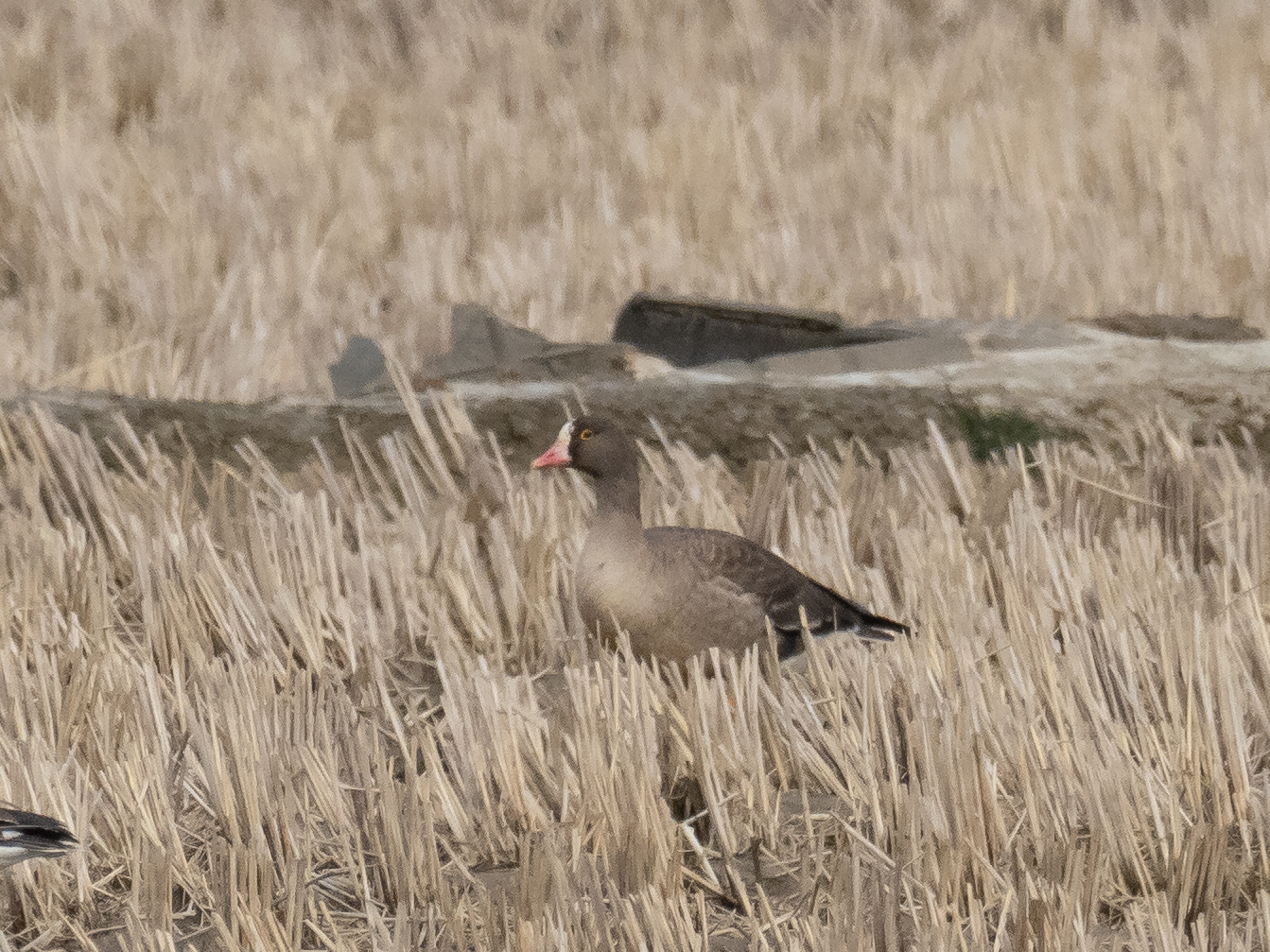
As we entered the reclaim area known as Area A we encountered a superb Eurasian Eagle owl silhouetted in the darkness as it perched atop a telegraph pole. A little further on eyeshine picked up in the car headlights was an Amur Leopard Cat which we saw rather too briefly and mainly in silhouette. We then entered the main site and sped past security which had been installed at the site to deter visitors. As the light gained we began to bird the fields, pools and water courses which dominate the area. On the pools we recorded abundant waterfowl including Eastern Spot-billed Duck, Smew, Goosander, Falcated Duck, Whooper Swan,Pochard and Goldeneye. The vast former area of tidal mudflats which now has a barage installed across its mouth supported Black-necked Grebe, Mongolian Gull and a single superb adult Steller’s Sea-eagle. However, it was the vast expanse of rich fields and watercourses which held the greatest birding interest with highlights including 17 Hooded Crane, three Bull-headed Shrike, one Chinese Grey Shrike, 10 Chinese Penduline Tit, five Dusky Warbler, 75 Buff-bellied Pipit, 150 Lapland Bunting, one Chestnut-eared Bunting, 50 Pallas’s Reed Bunting, 75 Rustic Bunting and 15 Black-faced Bunting. Flocks of mixed Tundra Bean Goose and Taiga Bean Goose proved challenging, the separation of these two being tricky even when birds are side by side. The highlight for me came as we found two Lesser White-fronted Goose amongst a flock of around 1,000 Greater White-fronts, their subtle structural differences and yellow eye-ring were studied in detail, this is a bird that I had long wanted to see. Mammal interest came in the form of two rather scruffy looking Racoon Dog, canids with a black mask and therefore having a resemblance to Racoon's. My eBird checklist for the morning can be viewed here.
Daurian Redstart - Seosan Reclamation (Area A), South Korea
Common Gull of subspecies kamtschatschensis - Seosan Reclamation (Area A), South Korea
Herring (Mongolian) Gull - Seosan Reclamation (Area A), South Korea
Mallard and Falcated Duck - Seosan Reclamation (Area A), South Korea
White-tailed Eagle - Seosan Reclamation (Area A), South Korea
Greater White-fronted Goose - Seosan Reclamation (Area A), South Korea
Hooded Crane - Seosan Reclamation (Area A), South Korea
Bull-headed Shrike - Seosan Reclamation (Area A), South Korea
Greater White-fronted goose with three Tundra Bean Goose (to right) - Seosan Reclamation (Area A), South Korea
Tundra Bean Goose - Seosan Reclamation (Area A), South Korea
Chestnut-eared Bunting - Seosan Reclamation (Area A), South Korea
Vinous-throated Parrotbill - Seosan Reclamation (Area A), South Korea
Rustic Bunting - Seosan Reclamation (Area A), South Korea
Rustic Bunting - Seosan Reclamation (Area A), South Korea
Rustic Bunting - Seosan Reclamation (Area A), South Korea
Rustic Bunting - Seosan Reclamation (Area A), South Korea
Rustic Bunting - Seosan Reclamation (Area A), South Korea
Rustic Bunting - Seosan Reclamation (Area A), South Korea
Brambling - Seosan Reclamation (Area A), South Korea
Brambling - Seosan Reclamation (Area A), South Korea
White-tailed Eagle - Seosan Reclamation (Area A), South Korea
Black Vulture - Seosan Reclamation (Area A), South Korea
Bull-headed Shrike - Seosan Reclamation (Area A), South Korea
Bull-headed Shrike - Seosan Reclamation (Area A), South Korea
Bull-headed Shrike - Seosan Reclamation (Area A), South Korea
Greater White-fronted Goose - Seosan Reclamation (Area A), South Korea
Long-tailed Tit - Seosan Reclamation (Area A), South Korea
Greater White-fronted Goose and Tundra Bean Goose - Seosan Reclamation (Area A), South Korea
Herring (Mongolian) Gull - Seosan Reclamation (Area A), South Korea
Steller's Sea-eagle - Seosan Reclamation (Area A), South Korea
Greater White-fronted Goose - Seosan Reclamation (Area A), South Korea
Lesser White-fronted Goose - Seosan Reclamation (Area A), South Korea
Lesser White-fronted Goose - Seosan Reclamation (Area A), South Korea
Greater White-fronted Goose - Seosan Reclamation (Area A), South Korea
Greater White-fronted Goose - Seosan Reclamation (Area A), South Korea
Taiga Bean Goose (right hand bird at rear) and Tundra Bean Goose - Seosan Reclamation (Area A), South Korea
Tundra Bean Goose - Seosan Reclamation (Area A), South Korea
After birding Area A we headed a short way along the road to Area B of the reclamation. A short detour towards the ‘bird observatory’ which seemed to be dominated by caged birds produced a vulture feeding station with some 46 Black Vulture, four White-tailed Eagle and a superb male Dusky Thrush. My eBird checklist for the bird observatory can be viewed here.
Black Vulture - Bird Observatory, Seosan Reclamation (Area A), South Korea
Black Vulture - Bird Observatory, Seosan Reclamation (Area A), South Korea
Continuing north to the small village of Bongrak-Ri we entered further reclaim habitat to the west of the village, this was Area B. Again the area was dominated by rice fields and ditches but this area seemed far less extensive and perhaps more disturbed than Area A. We flushed two Japanese Quail from roadside vegetation, a new bird for me. There were large numbers of Tundra Bean Goose and Greater White-fronted Goose and two Lesser White-fronted Goose were heard but the key birds here were a flock of 13 Oriental Stork. Some of these birds were unringed birds but were mainly ringed and from re-introduction program and included one Japanese ringed bird. My eBird checklist for the area can be viewed here.
As dusk fell, a short night drive produced at least three Racoon Dog, and at 18:30 we headed back to the hotel Vovo in Seosan and out for dinner and beers.
Oriental White Stork - Seosan Reclamation (Area B), South Korea
Oriental White Stork - Seosan Reclamation (Area B), South Korea
Oriental White Stork - Seosan Reclamation (Area B), South Korea