Showing posts with label Hooded Crane. Show all posts

Wednesday, 29 January 2020

South Korea and Taiwan - 29th January (Day 4)

Today we spent the entire day on the area known as the Seosan Reclamation, a vast expanse of land to the west of the city dominated by rice fields and reed lined water courses which has been reclaimed by the sea for potential future development. While still a haven for wildlife it is clear that the site is steadily being developed as land is sold-off with road improvements, canalisation of the water courses, construction of recreational areas etc all being signs of in-roads being made to the development of the site. The loud roaring of the F-16 fighter jets overhead dominated the soundscape which was otherwise made up of the constant cackling of tens of thousands of Greater White-fronted Goose, Taiga Bean Goose and Tundra Bean Goose.

As we entered the reclaim area known as Area A we encountered a superb Eurasian Eagle owl silhouetted in the darkness as it perched atop a telegraph pole. A little further on eyeshine picked up in the car headlights was an Amur Leopard Cat which we saw rather too briefly and mainly in silhouette. We then entered the main site and sped past security which had been installed at the site to deter visitors. As the light gained we began to bird the fields, pools and water courses which dominate the area. On the pools we recorded abundant waterfowl including Eastern Spot-billed Duck, Smew, Goosander, Falcated Duck, Whooper Swan, Pochard and Goldeneye. The vast former area of tidal mudflats which now has a barage installed across its mouth supported Black-necked Grebe, Mongolian Gull and a single superb adult Steller’s Sea-eagle. However, it was the vast expanse of rich fields and watercourses which held the greatest birding interest with highlights  including 17 Hooded Crane, three Bull-headed Shrike, one Chinese Grey Shrike, 10 Chinese Penduline Tit, five Dusky Warbler, 75 Buff-bellied Pipit, 150 Lapland Bunting, one Chestnut-eared Bunting, 50 Pallas’s Reed Bunting, 75 Rustic Bunting and 15 Black-faced Bunting. Flocks of mixed Tundra Bean Goose and Taiga Bean Goose proved challenging, the separation of these two being tricky even when birds are side by side. The highlight for me came as we found two Lesser White-fronted Goose amongst a flock of around 1,000 Greater White-fronts, their subtle structural differences and yellow eye-ring were studied in detail, this is a bird that I had long wanted to see. Mammal interest came in the form of two rather scruffy looking Racoon Dog, canids with a black mask and therefore having a resemblance to Racoon's. My eBird checklist for the morning can be viewed here.


Daurian Redstart - Seosan Reclamation (Area A), South Korea

Common Gull of subspecies kamtschatschensis - Seosan Reclamation (Area A), South Korea

Herring (Mongolian) Gull - Seosan Reclamation (Area A), South Korea

Mallard and Falcated Duck - Seosan Reclamation (Area A), South Korea

White-tailed Eagle - Seosan Reclamation (Area A), South Korea

Greater White-fronted Goose - Seosan Reclamation (Area A), South Korea

Hooded Crane - Seosan Reclamation (Area A), South Korea

Bull-headed Shrike - Seosan Reclamation (Area A), South Korea

Greater White-fronted goose with three Tundra Bean Goose (to right) - Seosan Reclamation (Area A), South Korea

Tundra Bean Goose - Seosan Reclamation (Area A), South Korea

Chestnut-eared Bunting - Seosan Reclamation (Area A), South Korea

Vinous-throated Parrotbill - Seosan Reclamation (Area A), South Korea

Rustic Bunting - Seosan Reclamation (Area A), South Korea

Rustic Bunting - Seosan Reclamation (Area A), South Korea

Rustic Bunting - Seosan Reclamation (Area A), South Korea

Rustic Bunting - Seosan Reclamation (Area A), South Korea

Rustic Bunting - Seosan Reclamation (Area A), South Korea

Rustic Bunting - Seosan Reclamation (Area A), South Korea

Brambling - Seosan Reclamation (Area A), South Korea

Brambling - Seosan Reclamation (Area A), South Korea

White-tailed Eagle - Seosan Reclamation (Area A), South Korea

Black Vulture - Seosan Reclamation (Area A), South Korea

Bull-headed Shrike - Seosan Reclamation (Area A), South Korea

Bull-headed Shrike - Seosan Reclamation (Area A), South Korea

 Bull-headed Shrike - Seosan Reclamation (Area A), South Korea

Greater White-fronted Goose - Seosan Reclamation (Area A), South Korea

Long-tailed Tit - Seosan Reclamation (Area A), South Korea

Greater White-fronted Goose and Tundra Bean Goose - Seosan Reclamation (Area A), South Korea

Herring (Mongolian) Gull - Seosan Reclamation (Area A), South Korea

Steller's Sea-eagle - Seosan Reclamation (Area A), South Korea

Greater White-fronted Goose - Seosan Reclamation (Area A), South Korea
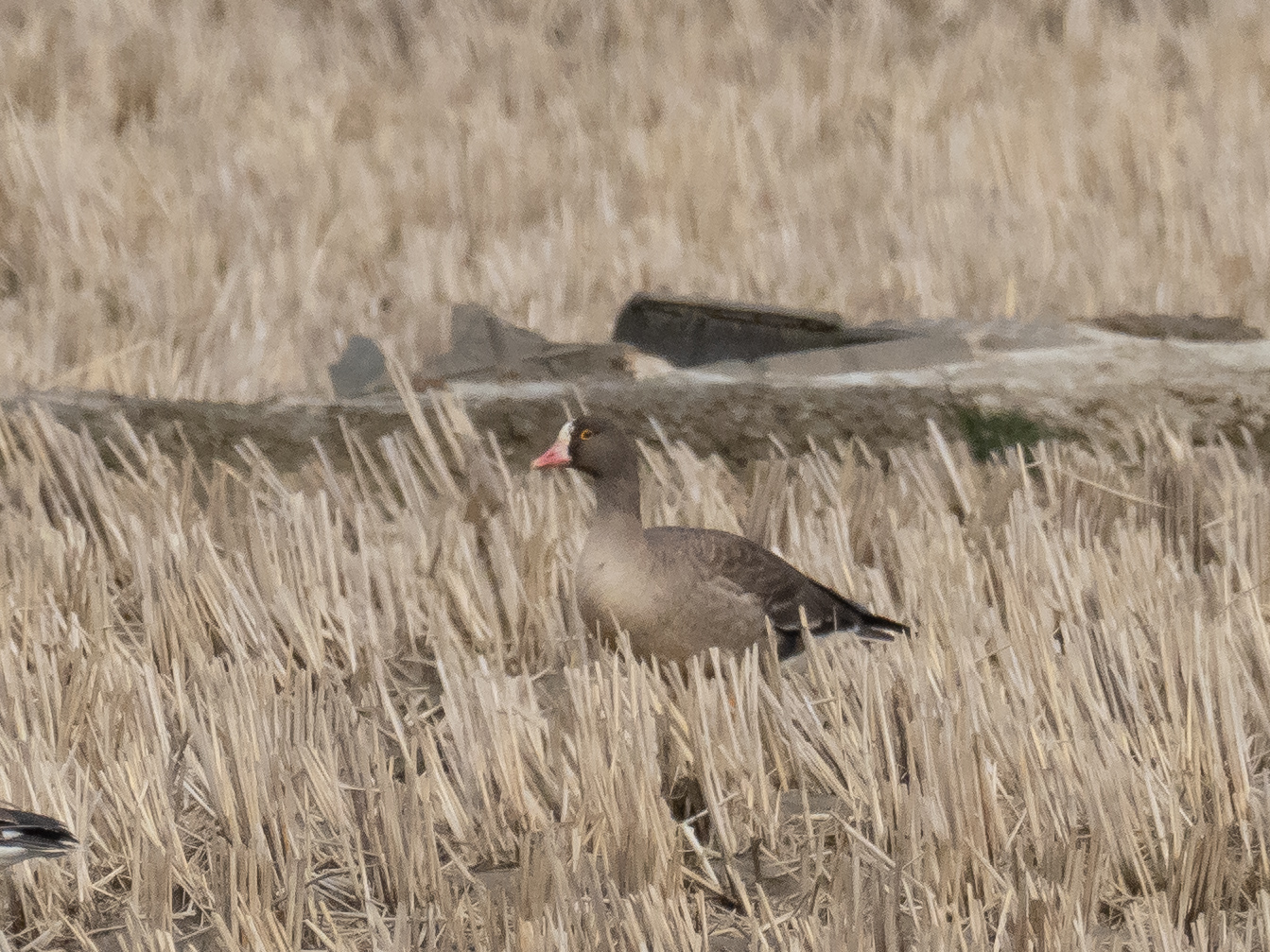
Lesser White-fronted Goose - Seosan Reclamation (Area A), South Korea

Lesser White-fronted Goose - Seosan Reclamation (Area A), South Korea

Greater White-fronted Goose - Seosan Reclamation (Area A), South Korea

Greater White-fronted Goose - Seosan Reclamation (Area A), South Korea

Taiga Bean Goose (right hand bird at rear) and Tundra Bean Goose - Seosan Reclamation (Area A), South Korea

Tundra Bean Goose - Seosan Reclamation (Area A), South Korea

After birding Area A we headed a short way along the road to Area B of the reclamation. A short detour towards the ‘bird observatory’ which seemed to be dominated by caged birds produced a vulture feeding station with some 46 Black Vulture, four White-tailed Eagle and a superb male Dusky Thrush. My eBird checklist for the bird observatory can be viewed here.

Black Vulture - Bird Observatory, Seosan Reclamation (Area A), South Korea

Black Vulture - Bird Observatory, Seosan Reclamation (Area A), South Korea

Continuing north to the small village of Bongrak-Ri we entered further reclaim habitat to the west of the village, this was Area B. Again the area was dominated by rice fields and ditches but this area seemed far less extensive and perhaps more disturbed than Area A. We flushed two Japanese Quail from roadside vegetation, a new bird for me. There were large numbers of Tundra Bean Goose and Greater White-fronted Goose and two Lesser White-fronted Goose were heard but the key birds here were a flock of 13 Oriental Stork. Some of these birds were unringed birds but were mainly ringed and from re-introduction program and included one Japanese ringed bird. My eBird checklist for the area can be viewed here.

As dusk fell, a short night drive produced at least three Racoon Dog, and at 18:30 we headed back to the hotel Vovo in Seosan and out for dinner and beers.

Oriental White Stork - Seosan Reclamation (Area B), South Korea

Oriental White Stork - Seosan Reclamation (Area B), South Korea

Oriental White Stork - Seosan Reclamation (Area B), South Korea

Links to Other Days of the Trip (Click to View)

South Korea

Taiwan

Monday, 14 November 2016

China Wetlands (Birdquest) Tour - 14th November (Day 11)

We awoke to a thick fog and so had breakfast at 06:30 and decided to head off from the Poyang Hu Reserve at Wu Cheng a day early to bird the mountain of Emei Feng. After breakfast in a small local restaurant we drove back across the causeway and stopped to scan the marshes of Poyang Lake as the fog lifted slightly, still in the hope that a Lesser White-fronted Goose maybe feeding with the Greater White-fronted Goose flock but it was not to be. A family party of three Hooded Crane gave us our best views yet - albeit in the fog. We headed off on our drive, but a short diversion to a small village to the south-west of Wu Cheng produced a flock of around 1,500 Rook of the eastern race pastinator and 15 Daurian Jackdaw.

Two adult and a juvenile Hooded Crane - Poyang Hu Reserve, Wu Cheng

Wu Cheng Town

Rook of race pastinator which has a more feathered face than the nominate race in Europe - Near to Wu Cheng


Service station selling live crabs from Poyang Lake. Soft shelled turtles were also commonly seen for sale for eating at these service stations.

Well stocked service station

A short stop in Taining for lunch supplies and we were off climbing the winding mountain road of Emei Feng Mountain which we birded from around 16:00-18:15. Much of our birding was from the vehicle on a so called ‘Gamebird Drive’. This involved us slowly driving up the road to the summit, down the road and back again. As we drove we scanned the road and adjacent forested slopes for our key target species Koklas Pheasant, Elliot’s Pheasant and Cabot’s Tragopan. The very first pheasant that we saw was a fine male Elliot’s Pheasant in the grass on the roadside no more than five metres from the car, unfortunately, by the time we had stopped the bird had fled down a bank, across a river and into the forest. This stopped also produced White-crowned Forktail and Slaty-backed Forktail as well as Plumbeous Water-redstart. The next pheasant was a fleeting view of a female Silver Pheasant but we need not worry as we saw several more family parties including several fine males several of which showed well. Finally, higher up a male Koklass Pheasant flew from the roadside and gave brief but good flight views – this it seemed was to be typical of most of our sightings of this species over the coming day and a half.

Taining Town Market

Taining Town Market produce

Taining Town Market

Taining Town Market produce

Taining Town Market produce

Limestone karst between Taining Town and Emei Feng

Limestone karst between Taining Town and Emei Feng

Landscape between Taining Town and Emei Feng, the most scenic area we visited on the tour

Landscape between Taining Town and Emei Feng, the most scenic area we visited on the tour

Plumbeous Water-redstart - Emei Feng, Taining

White-crowned Forktail - Emei Feng, Taining

Slat-backed Forktail - Emei Feng, Taining

Silver Pheasant (female) - Emei Feng, Taining

Silver Pheasant (male) of race fokiensis - Emei Feng, Taining

Super Moon - Emei Feng, Taining

After dinner in the small village at the bottom of the mountain road we returned to our Hotel, the rather grotty and run-down Garden Lodge at the top of the Emeifeng Mountain road. We spent a while before bed enjoying the superb 'Super Moon' that was visible in the unusually clear skies . A super Moon occurs when a full Moon coincides with the Moon's closest approach to Earth. The super Moon this evening was the closest since 26th January 1948 and the next time a full Moon is even closer to Earth will be on 25th November 2034.

Life Birds;
  • Elliot’s Pheasant
  • Chestnut-collared Yuhina