Showing posts with label Magnificent Frigatebird. Show all posts

Sunday, 18 August 2019

North Seymour Island (Galapagos and Ecuador) - 18th August (Day 5)

We were up at 05:00 for our 06:00 departure from hotel near to Quito Airport for our 08:10 flight to Guayaquil. After a 45 minute stopover in Guayaquil we were heading for Baltra on the Galapagos Islands, a 1.5 hour flight. We passed through customs relatively quickly paying $100 per person entrance fee to the islands, on emerging from the airport we quickly connected with both Small Ground-finch and Medium Ground-finch . We then boarded a coach and transferred to the dock where we boarded the catamaran Nemo III our home for the next seven nights. Birds around the dock included our first Lava Heron, Blue-footed Booby, Brown Pelican and Magnificent Frigatebird. After boarding the boat we had a debrief and then lunch and while in harbour recorded our first White-vented Storm-petrel, Nazca Booby and Lava Gull.

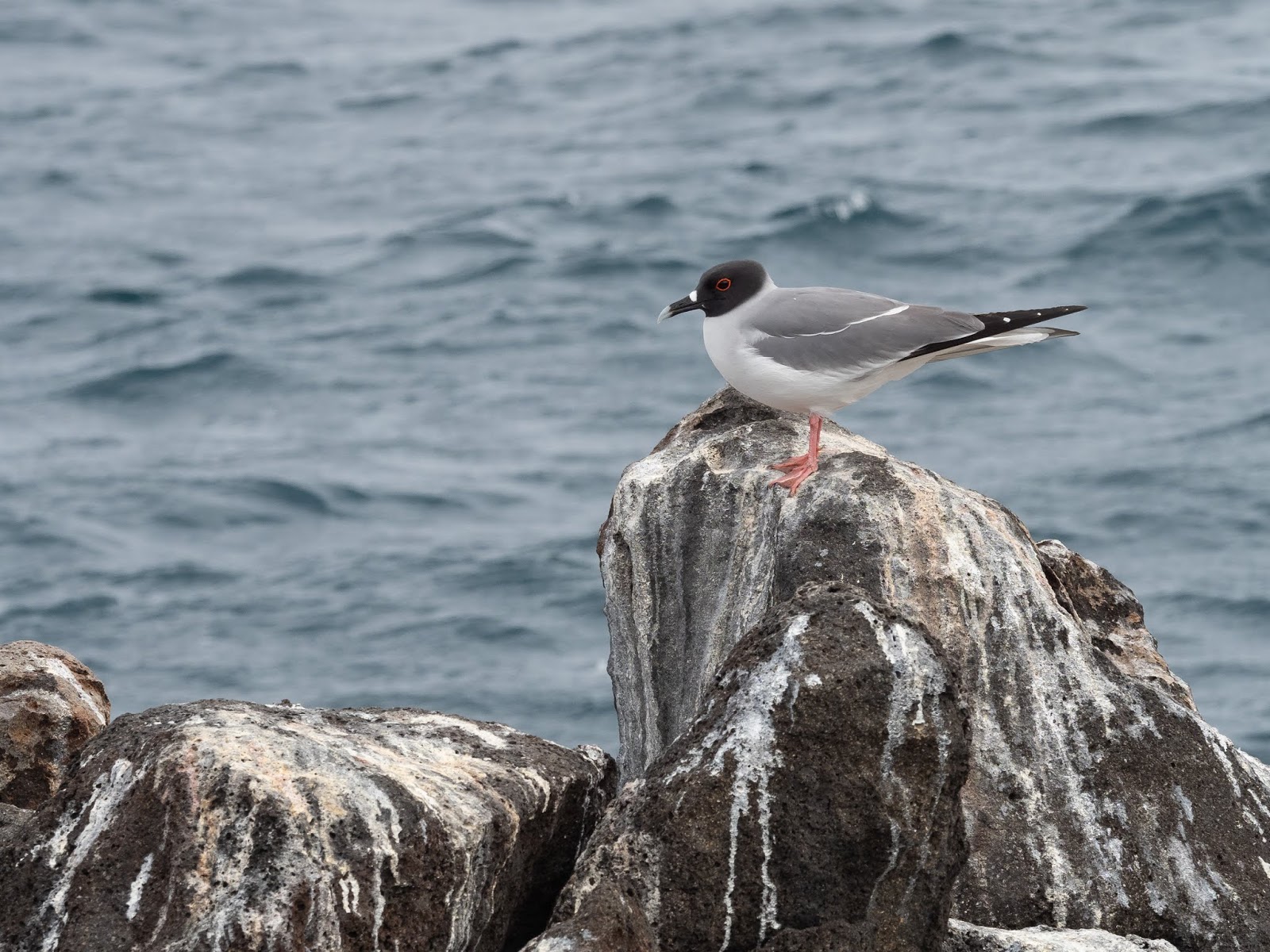
After lunch we steamed north for c.45 minutes to North Seymour Island where, as we approached shore, new birds included Galapagos Shearwater and our first stunning Swallow-tailed Gull as well as abundant Great FrigatebirdMagnificent Frigatebird, Brown Booby and Brown Pelican. Boarding the rib at around 14:30 we made the short journey to the landing and walked ashore surrounded by Swallow-tailed Gulls and Galapagos Sea-lion as Frigatebird's swooped low overhead. We did a circular walk of around 1km along the beach and then back through scrub in the centre of the island. Magnificent Frigatebird and Great Frigatebird (the more common) nested in the low shrubs, where many had well grown young. Dotted amongst these on the ground were Blue-footed Booby, some performing their courtship display while well grown, adult sized young wandered around independently. Other birds we recorded included Galapagos Dove and Yellow Warbler while large Land Iguanas (introduced on North Seymour), chomped their way through the endemic cacti. At 17:30 we headed back to the rib enjoying stunning views of Swallow-tailed Gull down to 3m in the evening sunlight.

After boarding the boat we headed southwards as the sunset, we picked up two Galapagos Petrel while the boat was accompanied by a flotilla of Frigatebird's and Globula Ray leapt from the water. We anchored in a sheltered bay where after a safety drill, crew introductions and dinner we steamed northwards towards Genovesa, a 10 hour overnight journey. It was fairly rough as we entered the open water and Sarah and Tobias feeling felt slightly queazy due to the motion of the boat - others suffered more considerably!

Swallow-tailed Gull - North Seymour Island, Galapagos Islands


Swallow-tailed Gull - North Seymour Island, Galapagos Islands


Swallow-tailed Gull - North Seymour Island, Galapagos Islands

Swallow-tailed Gull - North Seymour Island, Galapagos Islands

Swallow-tailed Gull - North Seymour Island, Galapagos Islands


Swallow-tailed Gull - North Seymour Island, Galapagos Islands


Swallow-tailed Gull - North Seymour Island, Galapagos Islands


Great Frigatebird - North Seymour Island, Galapagos Islands
Great Frigatebird - North Seymour Island, Galapagos Islands
Magnificent Frigatebird - North Seymour Island, Galapagos Islands

Magnificent Frigatebird - North Seymour Island, Galapagos Islands

Great Frigatebird - North Seymour Island, Galapagos Islands

Magnificent Frigatebird - North Seymour Island, Galapagos Islands

Magnificent Frigatebird - North Seymour Island, Galapagos Islands

Great Frigatebird - North Seymour Island, Galapagos Islands

Great Frigatebird - North Seymour Island, Galapagos Islands

Great Frigatebird - North Seymour Island, Galapagos Islands

Great Frigatebird - North Seymour Island, Galapagos Islands


Magnificent Frigatebird - North Seymour Island, Galapagos Islands

Frigatebird Sp. - North Seymour Island, Galapagos Islands

White-vented Storm-petrel - North Seymour Island, Galapagos Islands

White-vented Storm-petrel - North Seymour Island, Galapagos Islands

White-vented Storm-petrel - North Seymour Island, Galapagos Islands

White-vented Storm-petrel - North Seymour Island, Galapagos Islands

White-vented Storm-petrel - North Seymour Island, Galapagos Islands

Brown Pelican - North Seymour Island, Galapagos Islands

Brown Pelican - North Seymour Island, Galapagos Islands

Blue-footed Booby - North Seymour Island, Galapagos Islands

Blue-footed Booby - North Seymour Island, Galapagos Islands

Blue-footed Booby - North Seymour Island, Galapagos Islands

Blue-footed Booby - North Seymour Island, Galapagos Islands

Blue-footed Booby - North Seymour Island, Galapagos Islands

Blue-footed Booby - North Seymour Island, Galapagos Islands

Blue-footed Booby - North Seymour Island, Galapagos Islands

Blue-footed Booby - North Seymour Island, Galapagos Islands

Nazca Booby - North Seymour Island, Galapagos Islands

Galapago's Sea-lion - North Seymour Island, Galapagos Islands

Land Iguana - North Seymour Island, Galapagos Islands

Galapagos Lava Lizard - North Seymour Island, Galapagos Islands

Sally Lightfoot Crab - North Seymour Island, Galapagos Islands

Dead Fish - North Seymour Island, Galapagos Islands

Dead Land Iguana - North Seymour Island, Galapagos Islands

Links to Other Days of the Trip (Click to View)

14th August (Day 1) – International flight to Quito.
15th August (Day 2) – Mashpi Lodge.
16th August (Day 3) –Mashpi Lodge.
17th August (Day 4) – Mashpi Lodge and transfer to Quito.
18th August (Day 5) – Fly to from Quito to Galapagos Islands. Then sail to North Seymour Island.
19th August (Day 6) – Genovesa Island, Galapagos.
20th August (Day 7) – North-west Isabela Island and Fernandina Island, Galapagos. 
21st August (Day 8) – South-east Isabela Island, Galapagos.
22nd August (Day 9) – Espanola Island, Galapagos. 
23rd August (Day 10) – Floreana Island and Champion Island, Galapagos. 
24th August (Day 11) – San Cristobal Island and Sante Fe Island, Galapagos. 
25th August (Day 12) – Santa Cruz Island, Galapagos.
26th August (Day 13) – Fly Santa Cruz Island, Galapagos to Quito. 
27th August (Day 14) – Antisana Ecological Reserve then fly Quito to London. 

Wednesday, 1 May 2019

Playa de Oro then drive to Silanche (NW Ecuador) – 1st May (Day 7)

This morning was to be our last at Playa de Oro and we still had a fair bit to see. First, we were up pre-dawn and birded the forest in the dark trying for Choco Poorwill. We came to a small clearing where Gabo had previously seen the bird and played a recording- we listened but there was silence, just like our previous attempts at this bird. We played again and then a response but not in the clearing but by the lodge and so we retraced our steps and the bird was calling loudly from the clearing behind the lodge. A quick scan with the torches and some gleaming eyes, and there at last was a Choco Poorwill, rather a featureless dark Poorwill but a highly localised one.

After a quick breakfast we headed out onto the trail behind the lodge, at last it was dry and we were hopeful of seeing our last few target species for Playa de Oro. Walking the trail behind the lodge we very quickly came across one of our targets, a pair of Short-tailed Antbird which gave us prolonged views as they skulked in the undergrowth. Further along the trail we encountered Blue-tailed (Choco) Trogon and White-tailed Trogon, Spotted Antbird, Ocellated Antbird, a very confiding juvenile White-whiskered Puffbird and two Lemon-spectacled Tanager. A calling raptor was quickly identified by Gabo as a Plumbeous Hawk and after a quick blast of playback the bird appeared in the sub-canopy and showed well. This left just one bird, a bird that is perhaps easiest to see at Playa de Oro than anywhere else and one which we had trawled for almost from our first day at the reserve. Time was running short and Gabo suggested we walk another 10 minutes before we needed to turn back. A final blast on the tape and at last a response and before long we were watching our target, the rather drab Sapayoa. Dull in plumage, the Sapayoa is a taxonomic anomaly having been classified variously with Manakins and Tyrant Flycatchers of the New World, the Asity's of Madagascar and more recently Broadbills of Asia and Africa. The species is now considered to be in a monotypic family placed between the African and Asian Broadbills - a rather remarkable species. After watching this bird for ten minutes or so it was time to turn back, on the way back to the lodge we had good views of another Sapayoa, quite remarkable given that we had spent three days here without seeing one.

Blue-tailed Trogon - Playa de Oro, Ecuador

Blue-tailed Trogon - Playa de Oro, Ecuador

Red-capped Manakin - Playa de Oro, Ecuador

Red-capped Manakin - Playa de Oro, Ecuador

White-whiskered Puffbird - Playa de Oro, Ecuador

Spotted Antbird - Playa de Oro, Ecuador

Plumbeous Hawk - Playa de Oro, Ecuador

Plumbeous Hawk - Playa de Oro, Ecuador

Sapayoa - Playa de Oro, Ecuador

Sapayoa - Playa de Oro, Ecuador

The village of Playa de Oro, Ecuador

Back at the lodge we packed and loaded the boats before heading off at just gone 11:00 and were back to Selva Alegre at just gone 12:00. We headed to a nearby forest patch where we birded the busy road where the key bird was Slaty-tailed Trogon and after getting good views we commenced our four hour drive to Silanche - it was good to leave this rather noisy stop after the tranquility of Playa de Oro.

Capuchin Monkey - Near to Selva Alegre, Ecuador

Darter species - Near to Selva Alegre, Ecuador

Palm Oil being transported to factory, one of the biggest threats to the existence of rainforests in Ecuador - Near to Selva Alegre, Ecuador

Choco Trogon  - Near to Selva Alegre, Ecuador

En-route to Silanche we stopped for a massive fish lunch on the beach at Playa las Penas  and watched Magnificent Frigatebird and Royal Tern cruise by. After lunch we birded the marshes behind the town seeing a range of new trip birds including Yellow-crowned Night-heron, Ringed Kingfisher, Black-bellied Whistling-duck, Fulvous Whistling-duck, Striped Cuckoo, Purple Gallinule, Cocoi Heron, Hook-billed Kite, Pacific Parrotlet, Peruvian Meadowlark and the highlight, a stunning Pinnated Bittern. However, there was no sign of our main target, Masked Duck.

We then headed west following the Pacific coastline before heading inland on the E20 at Esmeraldas. We arrived at the Hotel Apollo in Pendro Bicente Maldonado at 19:00 and after dinner in a neighbouring restaurant we crashed at around 22:00 to a rather sleepless night awoken constantly by barking dogs - one of the blights of the modern world.

The town of Playa las Penas, Ecuador

Magnificent Frigatebird - Playa las Penas, Ecuador

Yellow-crowned Night-heron - Playa las Penas, Ecuador

Ringed Kingfisher - Playa las Penas, Ecuador

Chestnut-throated Seedeater - Playa las Penas, Ecuador

Striped Cuckoo - Playa las Penas, Ecuador

Peruvian Meadowlark - Playa las Penas, Ecuador

Pacific Hornero - Playa las Penas, Ecuador

Links to Other Days of the Trip (Click to View)