Showing posts with label Buzzard. Show all posts

Thursday, 27 September 2018

Isle of Wight and Pennington Marsh - 25th September

It was my birthday and as with previous years I planned to go birding for much of the day. I had a survey to complete on the Isle of Wight so I booked the earliest ferry from Lymington to Yarmouth at 05:30 to give me time at St. Catherines Point before my survey. The alarm went off at 03:45 but I had actually been awake since 02:00 and as I stepped outside I was greeted by darkness and a glowing harvest moon. I was on the island by 06:00 and stopped above Freshwater Bay as the sun was rising to enjoy the moon over Tennyson Down.

Harvest moon over Romsey

Moon over Freshwater Bay and Tennyson Down

Arriving at St. Catherine's Point I began the morning by standing to the west of the lighthouse and watching the visible migration. There was a steady stream of Meadow Pipit, a few Pied/White Wagtail, LinnetChaffinch and Siskin. Hirundine passage (mainly Swallow but a few House Martin) was fairly dramatic with a trickle of birds initially but then for around 30 minutes a flood of birds with approximately 150 birds passing east every minute.  However, by 08:00 this pulse of birds again eased off to a trickle. At 08:15 I gave up on the vis mig, which had all but stopped and headed to the bushes. First, I birded the East Fields before heading along the slope behind Knowle Farm, up through Hanging Valley and back through Wood Warbler Valley. It was fairly slow going, there seemed to be good numbers of Chiffchaff and Blackcap but little else. I watched a Hobby chasing Hirundines over Wood Warbler Valley and a Spitfire performing loop-the-loops but the birding had pretty much tailed off. After a coffee watching a Red Squirrel at the top of the Lighthouse Road I headed west.

Visible Migration Totals (06:30-08:15, all birds moving east):

Hirundine - 362 up to 07:30 then approx. 4,500 through between 07:30 to 08:00.
Pied Wagtail - 32
Grey Wagtail - 1
Yellow Wagtail - 4
Meadow Pipit - 217
Chaffinch - 3
Linnet - 65
Siskin - 9

Totals from my walk around:

Hobby - 1
Blackcap - 22
Whitethroat - 5
Chiffchaff - 25
Stonechat - 8
Wheatear - 2

Weather: Early wind NE F2-3 25% cloud cover and chilly. By 09:00 wind SE F3-4 and warm.

Chiffchaff - East Fields, St. Catherine's Point

Blackcap - Hanging Valley, St. Catherine's Point

Carrion Crow dwarfed by two Raven - Wood Warbler Valley, St. Catherine's Point

Juvenile Hobby - Wood Warbler Valley, St. Catherine's Point

Carrion Crow and Buzzard - Wood Warbler Valley, St. Catherine's Point

Spitfire KJI SM520 over St. Catherine's Point - More information on this plane can be read here

Red Squirrel - Lighthouse Road, St. Catherine's Point

Birding the pools along the Western Yar at Mill Copse was pretty slow going, a flock of 55 Mediterranean Gull, three Sandwich Tern, 150 Black-tailed Godwit, 15 Golden Plover and a single Spotted Redshank was all that I recorded. I decided to head to my survey and get an earlier ferry home to get to Pennington Marsh so that I could at least see something of a little more note on my birthday.

Mediterranean Gull (1st winter) - Western Yar, Yarmouth

At Pennington Marsh I only had 1.15 hours before collecting Tobias from school so I headed straight for Fishtail and Butts Lagoon. My first scan of Butts Lagoon produced the Temminck's Stint feeding on the north shore. Also here were 15 Dunlin and four Snipe. I then headed to Fishtail Lagoon where a Grey Phalarope showed down to seven metres on the channel between Fishtail and Butts Lagoon - what a stunning little bird. Finally, on Butts Lagoon were three Spotted Redshank and a Curlew Sandpiper. After such an early start I was knackered and it was time to collect Tobias and head home for dinner and some wine.

Here are a few images of the Grey Phalarope on the channel between Butts and Fishtail Lagoon, I first saw this bird on 22nd September, its becoming like an old friend!


Monday, 25 May 2015

Isle of Wight Weekend 15th-17th May

Sarah, Tobias and I had a weekend on the Isle of Wight to catch-up with my family but I also hoped to get out and about a little. After a hideous wet day on 15th I decided to head for St. Catherine's Point early on the 16th for a bit of seawatching even though the wind was firmly in the west, this was a last ditch attempt to see Pomarine Skua this spring after several failed attempts at Hurst Spit and Milford on Sea but it was not to be and the spring could well be Pom-less. There was little moving in the two hours that I gave it, 125 Gannet, six Manx Shearwater, two Sandwich Tern and four Kittiwake all moving east. I decided to have a stomp around the bushes but again it seemed pretty quiet with two Lesser Whitethroat, a Reed Warbler and a single Spotted Flycatcher. A Red Squirrel showed very well at the top of the lighthouse road, a species I have only seen on a handful of times at St. Catherine's.

The 16th was spent with my family and I had a very welcome lie-in for a change. I was back at St. Catherine's Point on 17th in a south-west and again didn't expect to see a great deal - although the hope for a Pom was ever present. One Manx Shearwater moving west, a handful of Gannet and six Common Scoter east was all that was seen in two hours of watching so I gave up and wandered the bushes but it was very slow going. I decided to have a quick dash in the now sunny conditions to one of my favourite butterfly spots and one that I have been visiting for around 20 years now, Brook and Compton Downs. This site is a fantastic expanse of chalk downland owned and managed by the National Trust. I parked in the small car park near to Brook Hill House at SZ 3947 8506 and walked west along the foot of the downs to approximately SZ 3853 8513. The track running along the foot of the downs faces south and rapidly warms in the morning and it is an excellent location to see many of the species present. The first section of path supports a colony of Wall Brown, a very localised species in Hampshire now, and it was good to see around five on the wing. Dingy Skipper were abundant with perhaps 35 seen.

Wall Brown

Dingy Skipper

Buzzard - Two at Brook Down kept an eye on what I was doing

Stoat - This animal ran up the path towards me and was a little shocked to see me standing there 

At my most westerly location at SZ 3853 8513 there is a small quarry and this is an excellent location for Small Blue and around 15 were present, some of which had clearly very recently emerged. This is a good location for Adonis Blue but despite hunting high and low none were to be seen, my first Common Blue of the year was a welcome sight though. Walking back to the car, I followed one of the many livestock paths that contours the down. I scanned the bramble bushes and eventually picked out a Green Hairstreak, this is a species that is relatively common on the scattered scrub on the downs but can be somewhat elusive unless one knows the traditional patches of scrub where they occur.

Brook and Compton Down looking north-west to Freshwater Bay and Tennyson Down

Small Blue

Common Blue

Green Hairstreak

I spent the last 30 minutes in the quarry by the carpark, this is a fantastic little spot for a diversity of butterflies and have have spent many hours here in the past. Grizzled Skipper, Dingy Skipper, Common Blue, Adonis Blue, Small Heath, Peacock and Wall Brown were all on the wing here.

Grizzled Skipper

Adonis Blue

Monday, 2 February 2015

Pennington Marsh - 1st February

Its been almost a month since I visited Pennington Marsh and I decided to brave the blasting northerly winds and sub-zero temperatures today. My plan was to spend the morning out birding but come 10:30 I was frozen and the thought of bacon sandwiches sent me scurrying for home - obviously getting soft! I parked at Lower Pennington Lane and did a quick dash out past Shoveler Pools to the jetty, west to passed Butts to Fishtail and then back to the car before sitting overlooking the floods off Lower Pennington Lane for 20 minutes or so. These were the highlights:

Two Rock Pipit fed on the seaweed at the base of the jetty........


......along with six Turnstone which showed well. Always fascinating birds to watch as they flip debris along the shoreline. I particularly like the last photo of a bird peering beneath a pebble.

The tide was very high and the saltmarsh was largely underwater and hence many of the waders were up and flying around as they were pushed off usual roosting sites.

Oystercatcher

Mixed flock of Grey Plover, Knot, Turnstone and Bar-tailed Godwit. The third bird from the right, a Bar-tailed Godwit, is in almost full summer plumage.

Also in summer plumage was this Great-crested Grebe just offshore at Butts Lagoon.

The saltmarsh was largely flooded during the high tide and these Brent Geese foraged in belly deep water. The left had bird is a first winter, the pale edges to the wing coverts still visible.

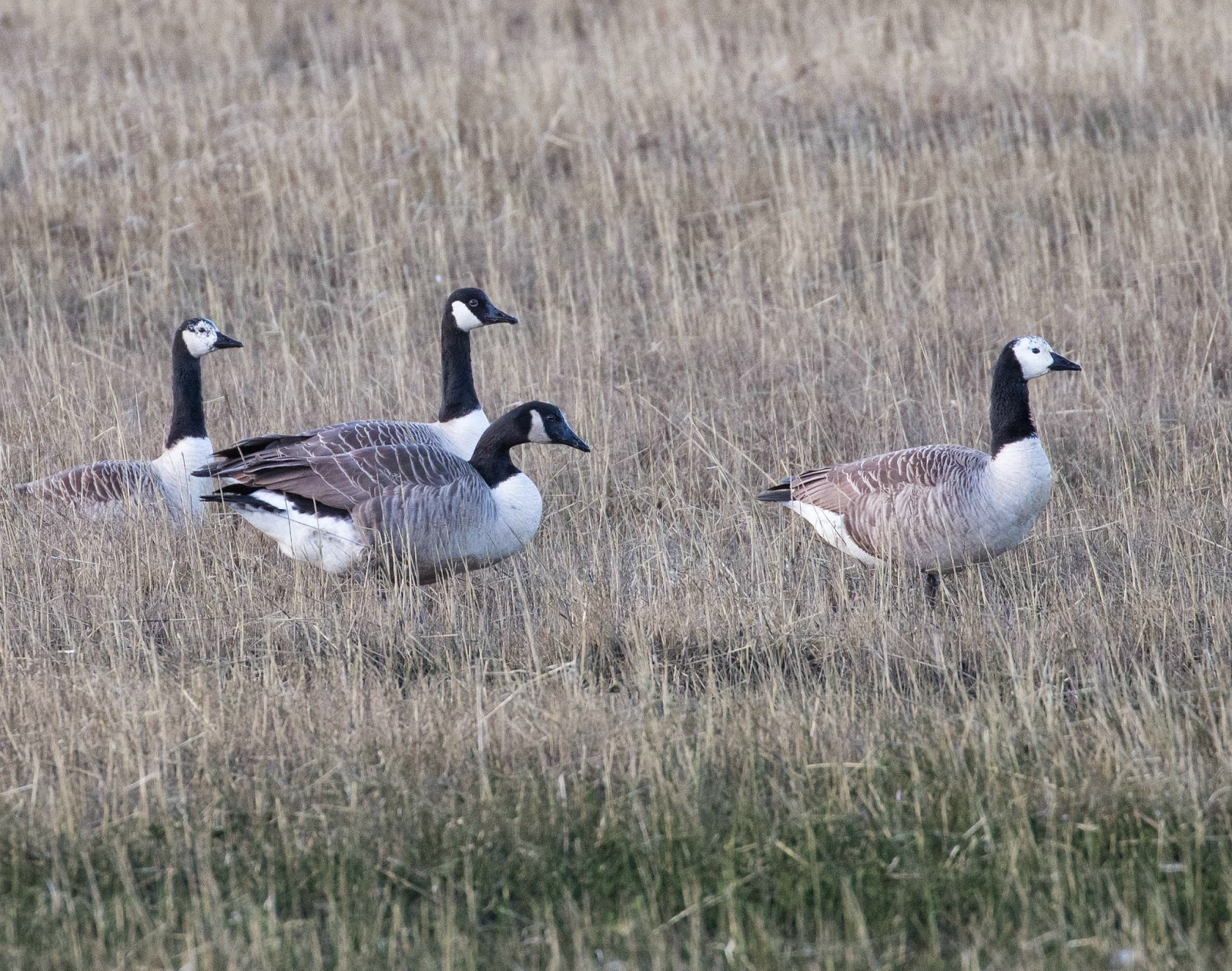
There were many Canada Geese on the saltmarsh including these two birds with extensive white on their foreheads.

A Peregrine kept harassing the birds at the site but it seemed to be for fun rather than with any real intent to capture prey.

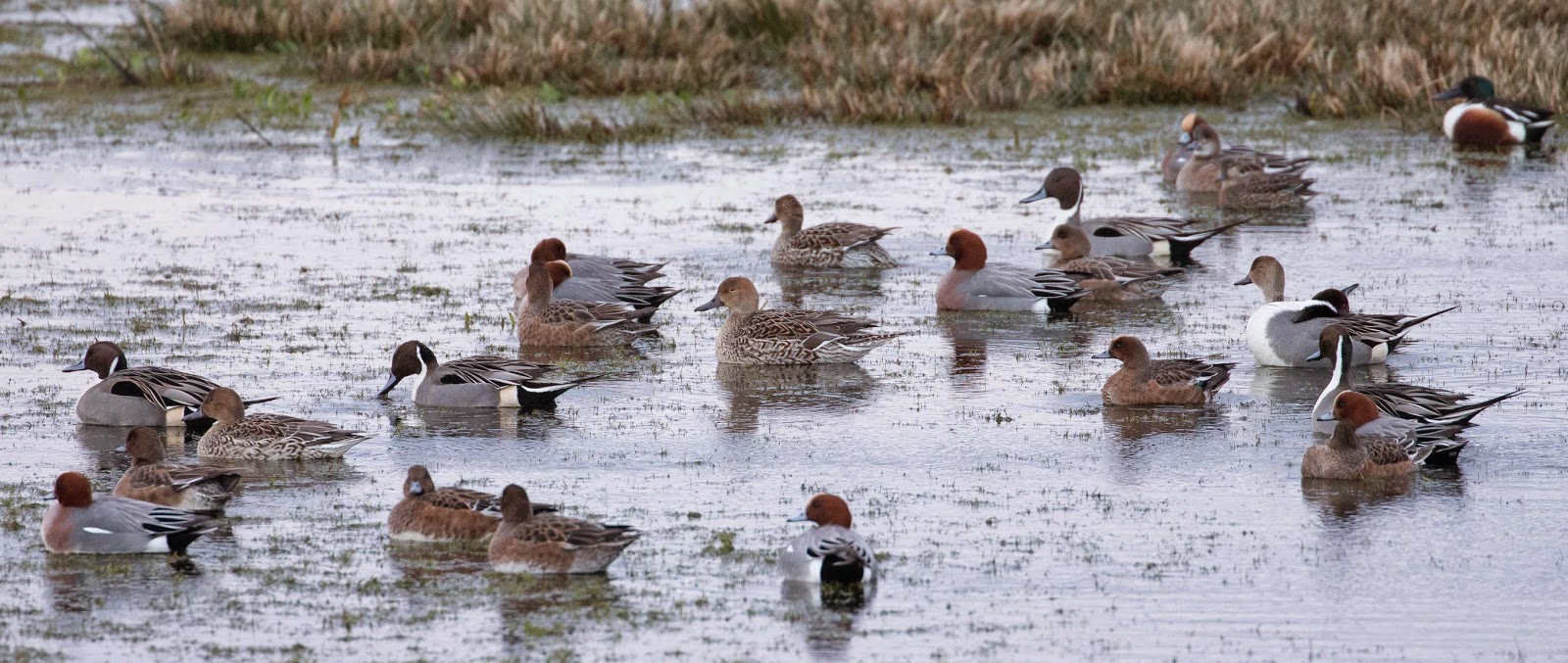
Mixed flock of Wigeon, Pintail and Shoveler on the floods at Pennington Marsh.

Buzzard with full crop flew low over Pennington Marsh putting up many of the birds


There were large numbers of Golden Plover on the floods at Pennington Marsh with around 500-700 birds. Unfortunately they were always in poor light and a little distant for decent photographs. There were also six Ruff amongst the gathered masses.

Monday, 1 December 2014

Pennington Marsh and Needs Ore Point - 28th November 2014

Its been a while since I have had a chance to get to Pennington Marshes so after a local bird survey I spent a couple of hours at Pennington with a short stop at Needs Ore Point. The undoubted highlight was a juvenile Spoonbill showing well on Efford Lagoon. For a Spoonbill it was relatively lively preening and wandering around, so often Spoonbills are content to stand on one leg for hours on end with their head tucked away.


I spent some time on the bend at the bottom of Lower Pennington Lane scanning the marshes. The water level is high here now and large numbers of birds are present with Wigeon, Shoveler, Teal, Pintail, Lapwing, Black-tailed Godwit, Curlew, Redshank and Starling being present in large numbers. Pintail numbers seem to be very good this year and I estimated at least 175 birds on the floods. Always a little on the distant side for good images, the below provides an indication of the spectacle on Pennington Marshes at the moment.

Mixed flock of Shoveler, Teal, Pintail and Black-tailed Godwit

Mixed flock of Lapwing and Starling

Mixed flock of Lapwing, Pintail, Teal and Black-tailed Godwit

The Brent Geese have taken to their usual field between the camp ground and Lower Pennington Lane. Today there were around 1,500 birds present, some of them showing fairly well. Brent Geese are fantastic birds and very evocative of our south coast marshes and mudflats. There were many juvenile birds present suggesting a good breeding season. While watching a group of three Peregrine pass north overhead flushing all the geese, they headed someway west before returning to feed in the same field.

Adult Brent Goose with a juvenile in the background told by the prominent white edges to the wing coverts

Brent arriving at the field to feed

Adult male and female Brent, the male (the left bird) has the bulkier head and bill

There were good numbers of gulls on Efford Lagoon with around 50 Herring Gull, 15 Great Black-backed Gull, 250 Black-headed Gull, 1 Mediterranean Gull and 15 Common Gull. Its great to have a gull spot at the site and I am sure numbers will begin to build here as the winter progresses and gulls begin to discover the site.

Herring Gull and Black-headed Gull - Most of the Herring Gull are adult with smaller 
numbers of 3rd winter birds

Great Black-backed Gull - A first winter bird

Great Black-backed Gull - Adults

Black-headed Gulls - The left hand bird shows a significant pink flush to the plumage which was more obvious in the field than here. The pigment responsible for this pink flush is thought to be Astaxanthin a Carotenoid. These are biosynthesised by plants and algae which are then consumed by crustaceans and fish which form part of the diet of many seabirds.

Mediterranean Gull - A second winter bird

Mediterranean (same bird as above) and Great Black-backed Gull - This Med Gull has a single dark tip to P7 as well as a dull bill showing that it is an immature bird

After spending some time at Efford Lagoon I wandered out to Fishtail Lagoon and back around Butts Lagoon. It was very blustery with a strong south-west wind blowing and the lagoons were fairly difficult to scan as a result. I spent some time at Fishtail Lagoon finding a sheltered spot and spent some time going through the birds that had gathered here, other than a Greenshank there was nothing much new but the Wigeon were performing well grazing round the lagoon margins while Pintail upended showing how they got their names to full effect. I spent a short while scanning the sea but it was very rough and difficult to find a sheltered spot from which to scan, four Red-breasted Merganser and three Great Crested Grebe were all that could be seen. I wandered back towards the car scanning Pennington Marshes once more. A female Marsh Harrier skimmed east and then back west across the marsh and flushed most of the birds but after wheeling around for a short while they soon settled. I then noticed a sizeable flock of around 250 Golden Plover, a good count for the site.

Two male and three female Wigeon - Wigeon spend a great deal of their feeding time 
grazing short swards adjacent to the waters edge

Pintail - Upending birds showing why they are called Pintail

Pintail - A male and one of my favourite ducks

Golden Plover - Part of a flock of 250 on Pennington Marsh

Curlew - Nice views alongside Lower Pennington Lane

Curlew - Foraging for Earthworms

I then headed for Needs Ore Point and spent a short while watching from the hides. It was very quiet but the sun was out and it was pleasant enough. There were small numbers of duck on the lagoons and a small flock of nine Avocet. It was now 14:00 and I needed to head home.

Mallard - Males were looking cracking in the late afternoon sun

Gadwall - Always look drab even in good light, up close the males are finely vermiculated grey adding a bit of interested

Buzzard - Grappling over the roadbeds at Needs Ore Poin

Buzzard - Grappling over the reedbeds at Needs Ore Point

Avocet - Flock of nine at Needs Ore Point