On the 16th Sarah and I headed up to Norfolk for a few days staying in a cottage in Great Bircham with our friends Julie and Trevor Codlin. It was Julie's birthday and the wives had wifey things planned for the 17th while the boys went birding and Tobias was with his cousins in Cheltenham - perfect.
On the morning of 17th we headed north from Great Bircham towards Titchwell pausing to scan the fields around Choseley where we saw around six
Corn Bunting and 12
Yellowhammer and picking up a few distant flocks of
Pink-footed Goose, a distant Harrier was probably a Hen Harrier but the bird disappeared before we were able to get a scope onto it. A call from the wives then interrupted our birding as we had to head back to Great Bircham as Sarah had no keys to the car and so she needed to borrow mine, while there they then convinced us to drive them to Burnham Market where they were to spend the day shopping - and drinking Champagne! From Burnham Market we headed to Titchwell after a somewhat delayed start. In the carpark at Titchwell two
Chiffchaff were showing well on the north edge of the car park and we spent a little while photographing these but they were a little high in a Sycamore. Walking through the Birch trees and out to the reedbeds we added
Bearded Tit (heard only),
Marsh Harrier (2),
Water Rail and
Redpoll to the day list. The various lagoons were remarkably empty and there was little of note with only small numbers of
Wigeon,
Teal,
Shoveler,
Dunlin (15),
Black-tailed Godwit (60) and three
Knot. We spend some time at the shore scanning to sea where a dispersed flock of several hundred
Common Scoter was very distant, single
Slavonian Grebe and
Eider, c.20
Red-breasted Merganser and
Great-crested Grebe were recorded. On the shore there were large numbers of
Common Gull,
Herring Gull and
Black-headed Gull and waders included
Bar-tailed Godwit and
Sanderling. Walking back from the shore past the lagoons the numbers of birds had increased with 34
Ruff, 35
Dunlin and approximately 175
Golden Plover plus an adult
Yellow-legged Gull.
Chiffchaff - Titchwell RSPB
Pink-footed Goose - Titchwell RSPB
Little Grebe - Titchwell RSPB
Golden Plover - Titchwell RSPB
Yellow-legged Gull - Titchwell RSPB
We then headed a short way west along the coast to Thornham where we fairly quickly located the flock of around 20 Twite that winter at the site. There was little else here and so we soon headed for our next destination which was to try to locate the main feeding gathering of Pink-footed Goose which forms one of the greatest wildlife spectacles in the UK.
Twite - Thornham
Twite - Thornham
Twite - Thornham
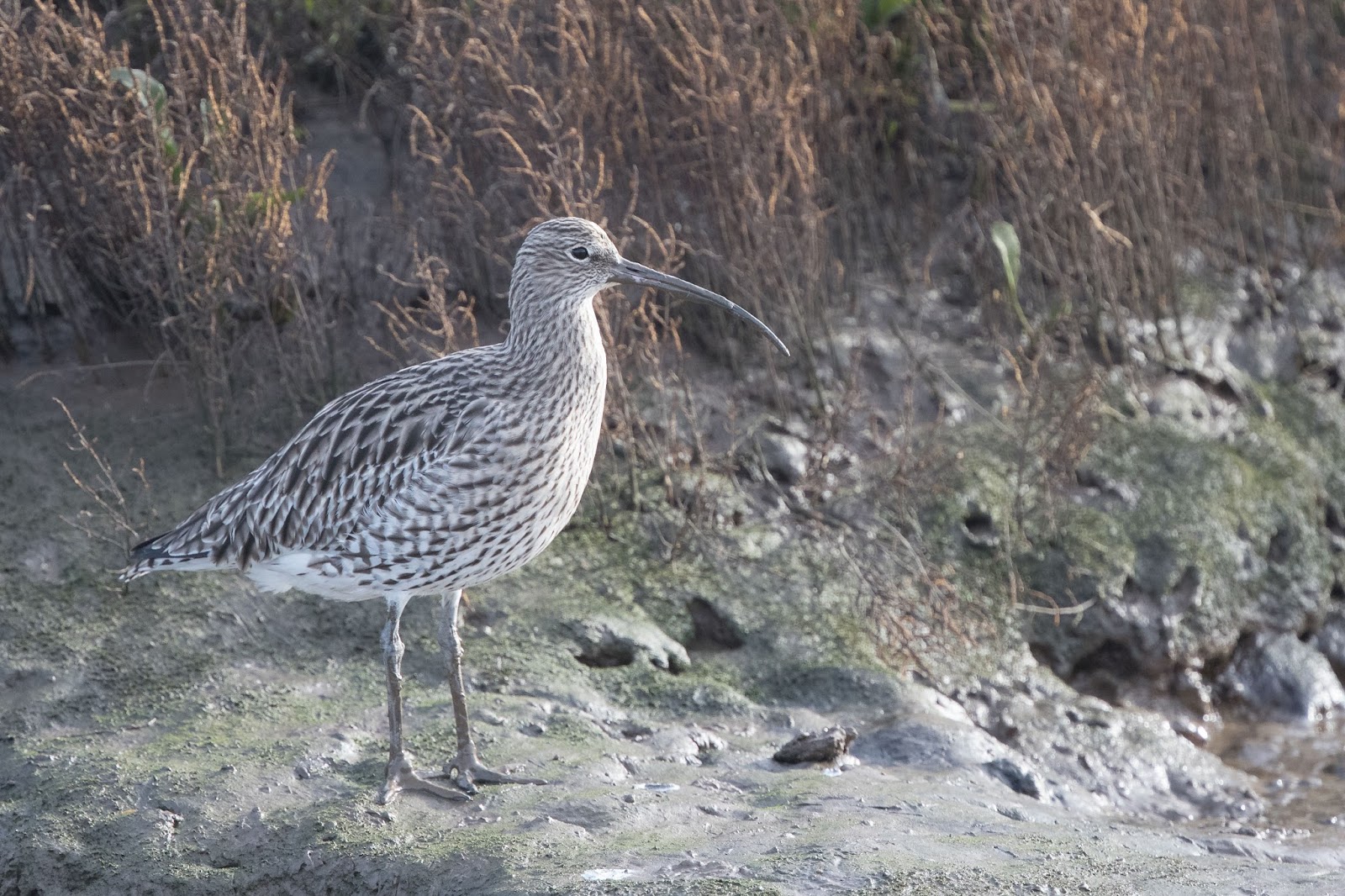
Curlew - Thornham
Redshank - Thornham
With a general tip-off that the main
Pink-footed Goose flock was feeding regularly on the road between Docking and Brancaster we headed in that general direction and it wasn't long before we located a distant flock of geese
dropping into the fields to the east of the road. After navigating the lanes towards the flock we soon came across the main flock feeding in fields off Docking Road to the north of Cradle Hall Farm. It was impossible to estimate the numbers present but there must have been in the region of 15,000 birds in the Sugar Beet and stubble fields. The images and recordings below give an impression of the site that confronted us, an amazing sea of geese and a deafening cacophony of sound. This is a sight that has to be seen and heard to appreciate is full impact.
And here are a couple of sound recordings, the first of a smaller flock flying over where the individual calls of the geese can be heard and the second of a huge flock taking flight and flying into the distance.
Sonogram of three calls of an individual Pink-footed Goose
After enjoying the geese and around 25 Grey Partridge in the same field, at 15:30 we had to head to Burnham Market to collect the wives and transfer them to Creake for hair appoinments while Trev and I headed to Lady Anne's Drive for dusk. We didn't see a great deal here although enjoyed views of flocks of Starling and Pink-footed Goose heading to roost and four Marsh Harrier dropping into their reedbed roosts for the night. After collecting the wives we headed for the cottage seeing a fly-over Barn Owl in the lights of the car.
Sunset at Lady Anne's Drive, Holkham
On the 18th we were up at 06:30 and by 08:15 were at Weybourne scanning a stubble field for three Lapland Bunting that had been present for the last couple of days. The stubble field was large and there was nothing for it but to walk across it to find the birds. Fairly quickly a flock of around 25 Sky Lark went up and within the flock Trev and I could here the calls of Lapland Bunting and soon located them as the Sky Lark flock circled us. After tracking the flock down once they had landed we soon obtained views of at least two Lapland Bunting but the views were fairly poor as the birds were rather distant and often hidden by stubble. Also in this field were four Golden Plover and a couple of Yellowhammer.
Heading west along the coast we stopped at Salthouse for an Iceland Gull that had been reported but with no luck. At Cley a 'Black Brant' was quickly found in a flock of round 200 Brent Goose, the North American subspecies being quickly apparent by its more black and white appearance, extensive white flanks and well defined white necklace, however, a wide range of intergrades occur. We then stopped at the beach carpark at Cley and walked for around one kilometre east of the car park along the shingle bank looking for a reported flock of Snow Bunting but we saw little, although around 10 Grey Seal offshore entertained us for a while as they played in the breakers. We then headed to Holkham to try and find our own Snow Bunting or Shore Lark but with no luck, in fact we saw little here but for 35 Egyptian Goose, many Pink-footed Goose and Greylag Goose, two Stonechat, 15 Sky Lark, Treecreeper, three Coal Tit and ten Goldcrest. We met with the wives at midday and after a short walk on the beach we retired to the Victoria for lunch and drinks.

'Black Brant' - Cley
Grey Seal - Cley
Shingle bar and Norfolk Wildlife Trust Reserve at Cley
The 19th was largely a driving day back to Hampshire (via Cheltenham to collect Tobias) and we reflected on a fantastic couple of days birding in Norfolk even through we had not seen any stand out bird species the Pink-footed Goose spectacle was a fantastic highlight of the weekend.