Sunday, 13 October 2019

Shetland - 12th October

I awoke at 06:15 after a good nights sleep and after breakfast I decided to head to the west coast of Shetland for an American Golden Plover and Bluethroat as well as some general birding. I started at Aith and birded the area just north of the village at North Gardie. There was a large flock of c.250 Golden Plover and it was not long before I located the American Golden Plover in the flock. The flock gave me the run around but eventually I had good views of the bird feeding alongside the road that runs north from Aith. The bird was in partial summer plumage and this, along with the grey plumage and large pale supercilium, made the bird fairly conspicuous amongst its commoner cousins. I then birded the village area seeing four Blackcap and two Brambling but little else.

Brambling (male) - Aith, Mainland Shetland

Brambling (female) - Aith, Mainland Shetland

American Golden Plover - Aith, Mainland Shetland

American Golden Plover - Aith, Mainland Shetland

Aith, Mainland Shetland

News broke of a Lesser Grey Shrike on Unst and having only seen one fairly poorly in the UK (a female at Corfe River Meadows, Middlebere, 14th August 2008) I decided to go for it. The bird had been found yesterday morning but had vanished for the rest of the day resulting in many birders missing it, but today the news services suggested it was settled and showing well and so the game was on.

I headed for the ferry terminal at Toft and arrived at around 11:45, I was standing around chatting when a stunning dark morph Honey Buzzard flew over head being mobbed by Gulls. The bird was almost black and its yellow cere and legs were prominent against such a dark plumage, the flight feathers were a little paler but essentially the entire bird was black; a stunning bird. I crossed to Yell and raced across the island. At the Gutcher ferry terminal on Yell I scanned across to the small island of Linga and picked up an Otter on the grass, it was playing on the clifftop before sliding into the water. After a short wait I was on the ferry and landed on Unst at around 12:45. After a 15 minute drive across the island I arrived at Burnside at Halligarth on the east coast of the island with six other birders. The Lesser Grey Shrike showed almost immediately and over the next hour I enjoyed fantastic views, as the bird fed from walls, posts and pylons often sallying to some height in pursuit of White-tailed Bumblebees. This was a fantastic adult bird with full black forehead and a lovely apricot wash to the underparts. At the end of my stay I was alone and had the bird down to around 15m as it fed along a fence line - this was a stunning bird and well worth the trip.

Dark Phase Honey Buzzard - Toft, Mainland Shetland

Ferry crossing to Yell, Shetland

Lesser Grey Shrike (adult) - Burnside, Halligarth, Unst, Shetland

Lesser Grey Shrike (adult) - Burnside, Halligarth, Unst, Shetland

Lesser Grey Shrike (adult) - Burnside, Halligarth, Unst, Shetland

Lesser Grey Shrike (adult) - Burnside, Halligarth, Unst, Shetland

Lesser Grey Shrike (adult) - Burnside, Halligarth, Unst, Shetland

Lesser Grey Shrike (adult) - Burnside, Halligarth, Unst, Shetland

Lesser Grey Shrike (adult) - Burnside, Halligarth, Unst, Shetland

Lesser Grey Shrike (adult) - Burnside, Halligarth, Unst, Shetland

I headed off from Unst at 14:30 and was back on the mainland at around 15:30. I contemplated heading to Ronas Hill for the Snowy Owl but thought better of it as I doubted that I would get back to the car with any daylight. Instead I stopped at Loch of Voe for a Red-breasted Flycatcher which showed well in the fading light. Heading to Lerwick I stopped at the docks where I had my first Wheatear of the trip and enjoyed good views of Black Guillemot. I retired to the Lerwick Hotel at 18:00. Maybe I will try for the Snowy Owl tomorrow afternoon if its a little slow elsewhere.

Rainbow over Loch of Voe, Mainland Shetland 

Red-breasted Flycatcher - Loch of Voe, Mainland Shetland

Red-breasted Flycatcher - Loch of Voe, Mainland Shetland

Black Guillemot - Lerwick, Mainland Shetland

Saturday, 12 October 2019

Shetland - 11th October

With a heavy workload at present I have spent more time looking at pictures of all the latest rarities on Twitter, Facebook and Birdguides than actually looking for my own rares. Yellow-billed Cuckoo and Black and White Warbler on the Isles of Scilly, Least Bittern Farranfore, Co.Kerry, Common Nighthawk Calgorm Co. Antrim and the amazing run of mega’s on Corvo including Hooded Warbler, White-eyed Vireo, Cape May Warbler and Prothontary Warbler on Corvo, Azores have been some of the highlights of an autumn dominated by a westerly airflow and American vagrants. The western areas of the UK have dominated the autumn rariety news while Shetland has had a relatively quiet season with the highlight being a Rufous-tailed Robin seen for five minutes on Fetlar and a possible Stejneger’s Stonechat on Unst, to date.

I had booked my visit to Shetland a little later than usual due to work and social commitments and so leading up to my departure on 11th I had been studying the weather charts on windy.com, it wasn’t looking great, a dominance of westerlies but for my weekend visit the winds were going north, north-east and east as a low pressure system moved east over north Scotland and into the Baltic regions with an east and then more north-east airflow coming off its northern edge. Some east in the system was encouraging but this was localised with the east flow only extending as far as Norway and the north Baltic area. Still, this was Shetland and there was always optimism.

My 07:05 flight from Heathrow to Aberdeen left on time and I arrived in Aberdeen at 08:10 I had a short wait until my 09:45 flight to Sumburgh which landed at 10:50. After collecting my car from Bolts Car Hire I drove straight to Grutness where I birded the beach and out to the obelisk on the headland. In the bay were Black Guillemot, a single Red-throated Diver and good numbers of Common Gull while on the headland I picked up my first Rock Dove, Twite, Merlin and a small flock of four Snow Bunting.

Snow Bunting - Grutness, Mainland Shetland

Snow Bunting - Grutness, Mainland Shetland

I then headed up to Garths Ness, beyond Quendale where a Short-toed Lark had been present since 4th October, I was told to sit in the car beside a patch of mud and the bird comes into this, I sat and waited but nothing and so I went for a short stroll around this beautiful headland. There were lots of Meadow Pipit in the grassland, Raven, a couple of Goldcrest around the ruined buildings and a Song Thrush on the cliffs. I eventually flushed the Short-toed Lark from the grassland and had brief flight views only. I then birded around the Quendale Mill area where a Common Chiffchaff, Siberian Chiffchaff, Blackcap and a Yellow-browed Warbler were the highlights. I was starting to flag and so went to the local store for snacks and a coffee.

Yellow-browed Warbler - Quendale, Mainland Shetland
Yellow-browed Warbler - Quendale, Mainland Shetland

I then headed to South Voe and birded the gardens around the Croft Museum where a Barred Warbler had been present. I scoured the gardens, which in places were dense, and had Chiffchaff, six Blackcap and a Merlin over. I decided to head off and as I drove south out of the village a couple of Whinchat beside the road made me stop, a movement below them and there low down in the dock was the Barred Warbler. I watched the bird for five minutes before it headed out across the fields towards the mill.

Merlin - South Voe, Mainland Shetland

Blackcap - South Voe, Mainland Shetland

 Barred Warbler - South Voe, Mainland Shetland

Barred Warbler - South Voe, Mainland Shetland

South Voe and the Croft Museum - Mainland Shetland

The light was beginning to fade and so I made one last stop at Netherton where 50 Redwing and 8 Fieldfare were the highlights. Two Harbour Porpoise were very close in shore at the bay. I headed for the hotel for a much needed cold beer and an early night.

Netherton, Sotuh Mainland

View from my room in the Lerwick Hotel

Wednesday, 9 October 2019

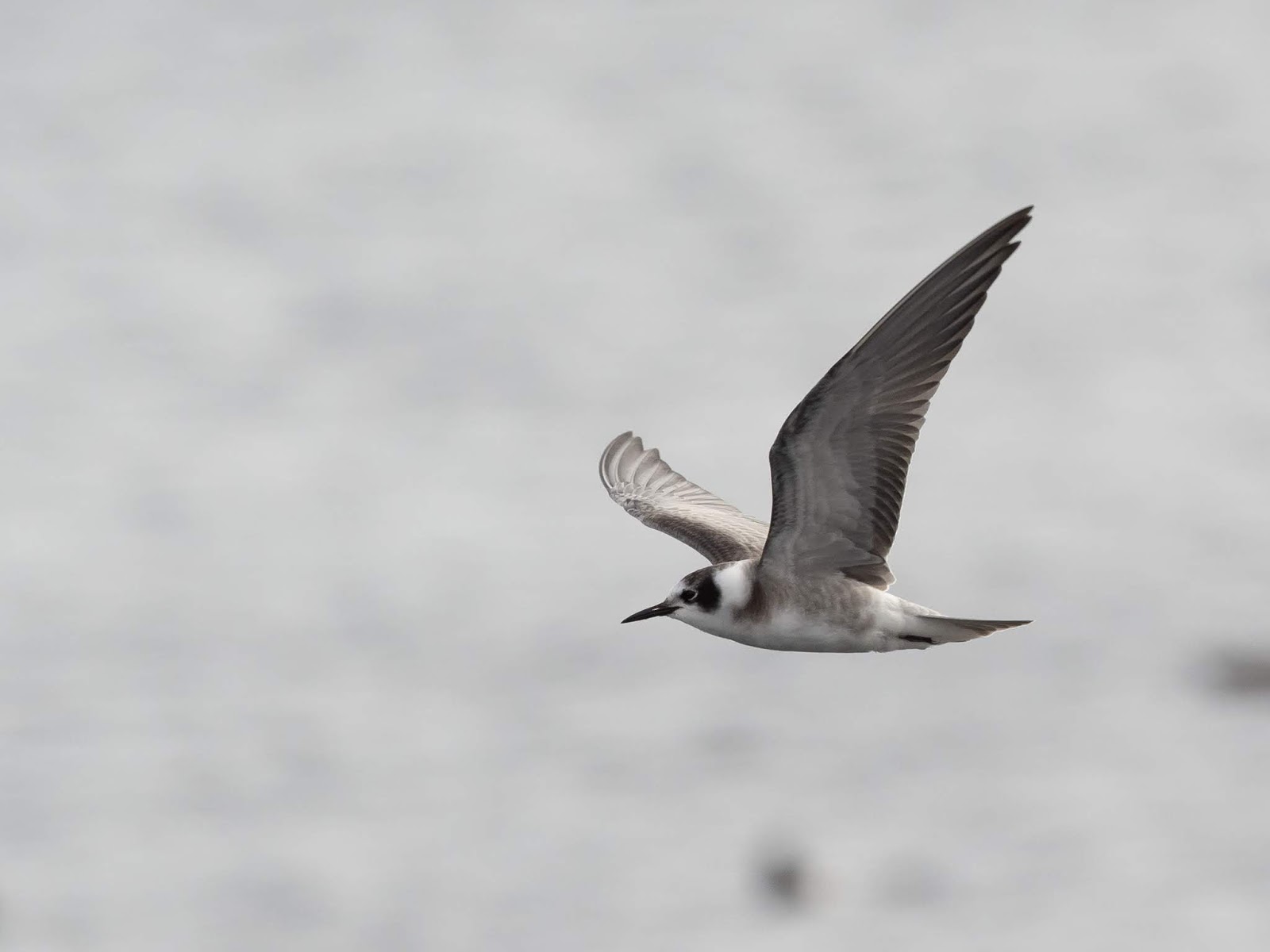
'American' Black Tern - Longham Lakes, Dorset - 9th October

On 5th October a juvenile Black Tern was found on Longham Lakes, Dorset which was subsequently identified as an 'American' Black Tern. This subspecies, surinamensis, of Black Tern is not widely split as a species from the nominate but differs, in juvenile plumage, in the following key features:
  • Dark ear covert patch contrasts with paler more streaky crown which is concolorous with the upperparts. In nominate the crown and ear-coverts are uniform and the crown darker than the upperparts.
  • Grey flank panel reaching trailing edge of wing which merges with the darker breast patch. In nominate the breast patch is isolated by the white flanks.
  • Smaller, more compact, shorter winged and overall darker than nominate.
I visited the site on 9th October and the bird was showing exceptionally well, on occasions, from the fishing platform in the north-west corner of the southern lake. The bird worked a circuit of the southern reservoir from the south-east corner to the north-west corner coming particularly close inshore when reaching the north-west corner.

I shot a lot of images of this bird but was a little disappointed with the results, primarily because I was shooting into the light but also because the bird had a very erratic, dipping, flight and I have not yet mastered the auto-focus of the E-M1X for in-flight shots.  I therefore had a high number of reject images.

The first British Record of this subspecies was at Weston-super-mare from 3rd-11th October 1999 there have been six accepted records  in Great Britain to the end of 2018. However, surely this species will become more regular as the field characters of the subspecies become more widely appreciated.


Monday, 7 October 2019

Normandy Marsh, Lymington - 7th October

Having spent the weekend in Lymington I found a spare hour to have a wander around Normandy Lagoon at Lymington, part of the Keyhaven/Pennington/Lymington Marshes complex. I wandered from the Yacht Haven Marina along the seawall around Normandy Lagoon and back up to Normandy Lane. The tide was on the fall from a very high level and there were good numbers of common waders including a few Knot, 14 Greenshank, three Spotted Redshank, c.75 Dunlin, c.30 Ringed Plover, and six Bar-tailed Godwit. Wildfowl numbers are beginning to increase and I recorded 65 Teal, 45 Wigeon and 16 Brent Goose. Passerines were in short supply and I only recorded two Wheatear, two Stonechat, a single Chiffchaff and small numbers of Swallow passing over to the west. There was a distinct autumnal feel to the environment with an abundance of Hawthorn and Bramble fruit in the hedgerows and the leaves beginning to yellow, the Salicornia on the saltmarsh was flushed a rich vinous red making a lovely back drop to marshes inhabitants.

Stonechat - Normandy Marsh, Hampshire

Redshank - Normandy Marsh, Hampshire

The Teal are in heavy moult and this individual was particularly scruffy - Normandy Marsh, Hampshire

Starling - Normandy Marsh, Hampshire

Renged Plover - Normandy Marsh, Hampshire

Greenshank - Normandy Marsh, Hampshire

Curlew - Normandy Marsh, Hampshire

Little Egret, this ringed bird is, I believe, from a Dutch ringing scheme- Normandy Marsh, Hampshire

Little Egret - Normandy Marsh, Hampshire

Little Egret - Normandy Marsh, Hampshire

Little Egret - Normandy Marsh, Hampshire