
On 19th we were up at 06:30, tidied the cottage and were on our way to Lands End airport for our 09:30 flight to St. Mary's. Arriving on Scilly at 09:50 on a beautiful sunny day we checked into the Star Castle Hotel and then headed out. We wandered out to Old Town Churchyard and spent some time here where the only birds were three Goldcrest and two Blackcap. There was no sign of the long staying Red-backed Shrike. We then headed through Lower Moors, a couple Yellow-browed Warbler called, the hide was devoid of birds and the long staying and confiding Spotted Crake did not show. After a relaxing lunch in Juliet's Cafe we headed out to Holy Vale where there were three Yellow-browed Warbler and then to Porth Hellick pool where there were eight Common Teal and 11 Snipe but no sign of the long staying Blue-winged Teal. It was now 15:45 and so we decided to head back to the Star Castle. A stop at Lower Moors produced a very brief view of the Spotted Crake and a single Water Rail which had just chased the crake away. It had been a slow start to our time on the islands but its always good to be back here.

Cot Valley as we flew from Land's End to Isles of Scilly

Grey Heron - St. Mary's, Isles of Scilly

Porthellick Pool, St. Mary's, Isles of Scilly
On 20th we headed over to St. Martin's and walked along the back of Par Beach before cutting up to the Day Mark and then headed back down to the road before walking along the spine of the island to the Karma Hotel in the west of the island where we had lunch. Birding was fairly slow going but there were large numbers of Redwing and Fieldfare with around 250 of the former and 50 of the latter. A Firecrest and two Yellow-browed Warbler were in the Middle Town area, a male Merlin on Chapel Down and two Stonechat. We caught the 15:30 back from St. Martin's and on arrival on St. Mary's we headed up to Lower Moors where the Spotted Crake was showing well as it preened in the boggy woodland at the Rosehill end of the trail. We watched the bird for a few minutes before it slipped away into the flooded woodland once again. We then headed to Porthloo Beach where there were around 45 Oystercatcher and a single Northern Wheatear. The main thing I wanted to see here was Portuguese Man' O War of which we soon came across five beached animals, although most were now bleached and colourless, one had retained its bright blue and pink colours. These strange creatures, dubbed locally as 'Purple Pasties', are not true jellyfish (which are single organisms) but a siphonophore, which is a colonial organism made up of many specialised animals (polyps) of the same species.

Greenfinch - St. Martin's, Isles of Scilly

Oystercatcher - St. Martin's, Isles of Scilly

View to north-west over St. Martin's from the Day Mark with White Island to the right
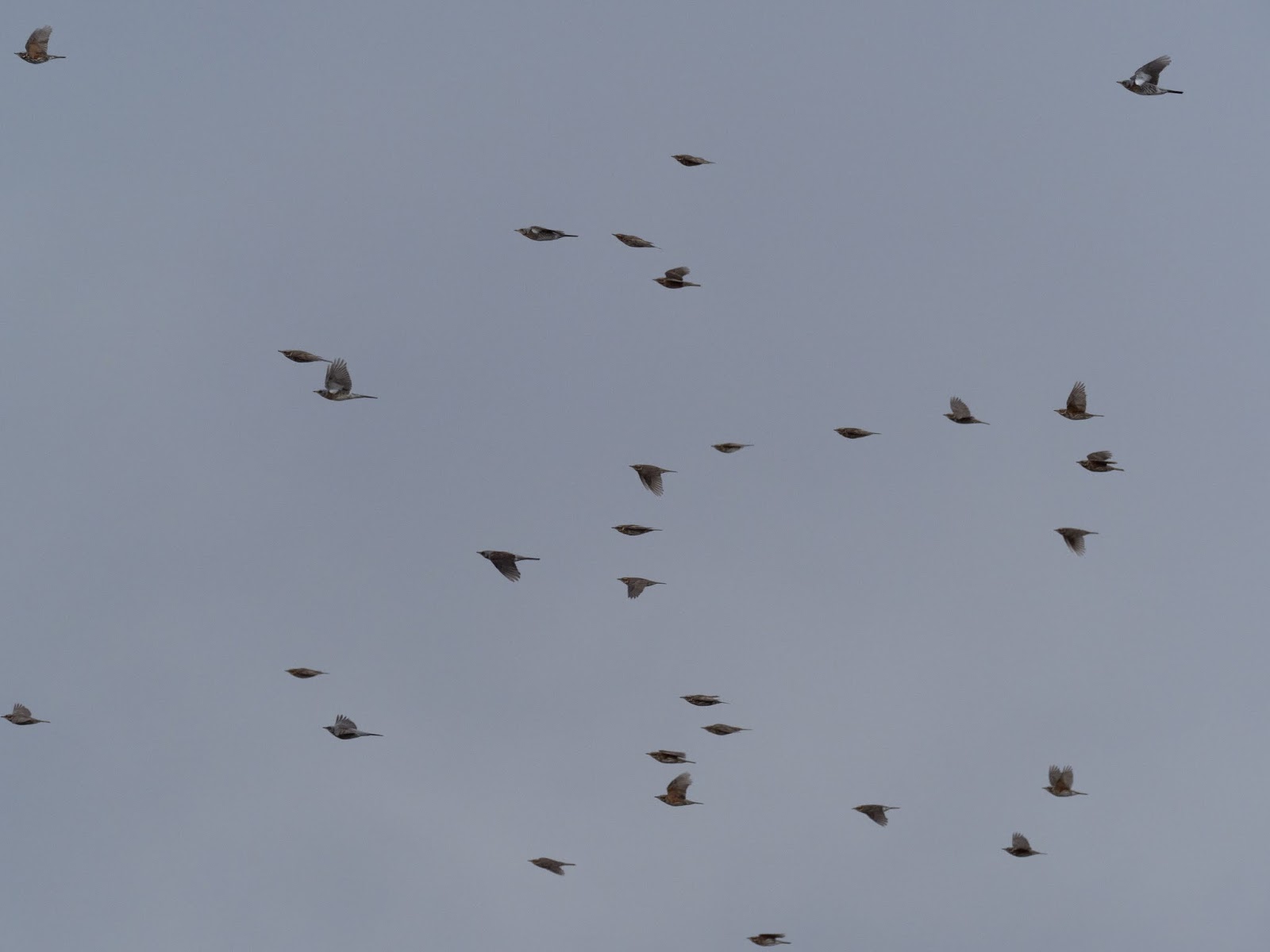
Redwing and Fieldfare - St. Martin's, Isles of Scilly

Dark Common Pheasant, these seem to be the common form present on St. Martin's - St. Martin's, Isles of Scilly

Redwing - St. Martin's, Isles of Scilly

Northern Wheatear - St. Martin's, Isles of Scilly

Spotted Crake - St. Mary's, Isles of Scilly

Spotted Crake - St. Mary's, Isles of Scilly

Spotted Crake - St. Mary's, Isles of Scilly

Spotted Crake - St. Mary's, Isles of Scilly

Spotted Crake - St. Mary's, Isles of Scilly

Portuguese Man O' War - St. Mary's, Isles of Scilly
On 21st we caught the boat across to St. Agne's, one of my favourite of all islands, and wandered out to Wingletang Down via the Gugh Bar and back down Barnaby Lane. It seemed fairly quiet and the highlights were two Swallow, a single Northern Wheatear, Chiffchaff and two Stonechat as well as moderate numbers of Redwing and Fieldfare. At the top end of Barnaby Lane 'pishing' into the elms produced a Goldcrest and a single Yellow-browed Warbler. We then dropped down through Middle Town to Porth Cloose where a Spotted Sandpiper showed well as it fed along the strandline seaweed mounds. After lunch at the Turks Head we were on the 14:15 ferry back to St. Mary's and enjoyed a wander around the Garrison where eventually the Blue Rock Thrush showed fairly well but a little distantly as it fed on the beach at Morning Point. This bird has been present since 22nd September and is my second in the UK after the Stow-on-the-Wold, Gloucestershire bird on 3rd February 2017. There was little else to be seen and so by 17:00 we were tucked up in the Atlantic with a pint.

Yellow-browed Warbler - St. Agne's, Isles of Scilly

Spotted Sandpiper - St. Agne's, Isles of Scilly

Spotted Sandpiper - St. Agne's, Isles of Scilly

Spotted Sandpiper - St. Agne's, Isles of Scilly
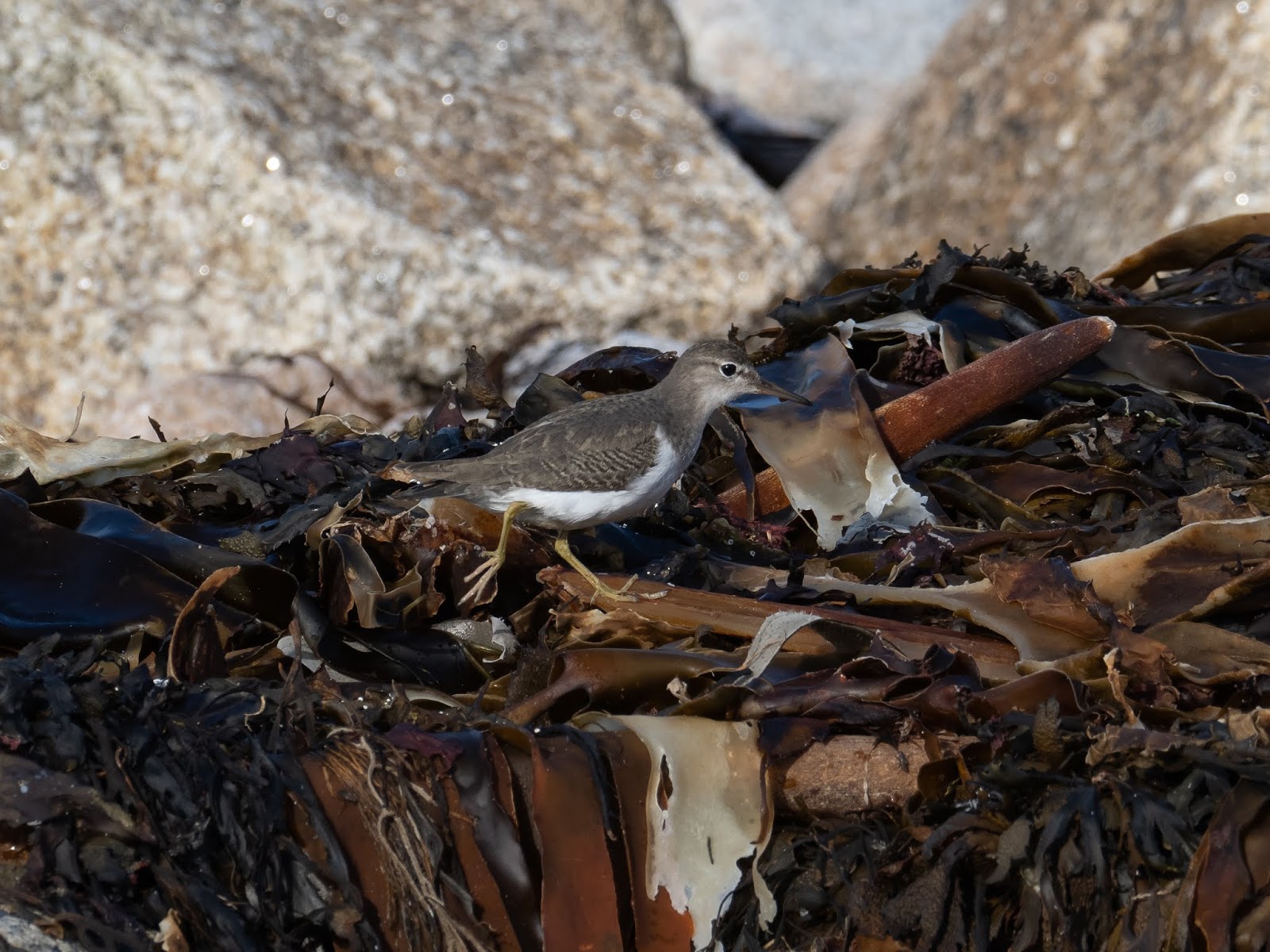
Spotted Sandpiper - St. Agne's, Isles of Scilly

Spotted Sandpiper - St. Agne's, Isles of Scilly

Blue Rock Thrush - St. Mary's, Isles of Scilly

Blue Rock Thrush - St. Mary's, Isles of Scilly

Blue Rock Thrush - St. Mary's, Isles of Scilly

View of St. Agnes from the Garrison, St. Mary's with the Scillonian
The 22nd was our final day and after breakfast we had a walk around the pines, campsite and Woolpack area of the Garrison where there were small numbers of Redwing, three fly-over Brambling, a couple of Goldcrest and a Chiffchaff. Spider collected us at 10:40 for our 11:40 flight and we stopped in Old Town where a New Zealand Spiny Stick Insect had been seen yesterday and after a bit of searching we found this superb 15cm insect dangling from a Pittosporum. Our flight was delayed by 50 minutes but our crossing was very smooth and the sea flat calm allowing us to see around 20 Common Dolphin from the air. We landed at Land's End at 12:45 and were home by 18:00.

New Zealand Spiny Stick Insect Micrarchus hystricuelus - Old Town, St. Mary's, Isles of Scilly


