Thursday, 24 December 2015

Australia, Fiji and New Caledonia - 26th November (Day 16)

Another early start we were heading for the Farino area and recent sightings of the elusive New Caledonian Thicketbird and a few additional endemics to see. We left the hotel at 05:15 and after much discussion stopped at two pic-nic areas 15km east of the turning to Farino on the Canala Road (07:00-09:00). On route we stopped at a perched juvenile accipiter which despite close views we could not definitively identify, the balance was in favour of the endemic White-bellied Goshawk rather than Brown Goshawk but we were unsure. There had been sightings of the thicketbird at the first pic-nic area at 14km two weeks before but alas despite much bashing of the grassland habitats (mainly by MK and AD) we were unsuccessful in our task. Birds seen in this area included Striated Starling (a nesting colony present) Glossy Swiftlet, Cloven-feathered Dove (at least six present and one bird seen), Yellow-bellied Robin and Goliath Imperial Pigeon.

Drinks were needed and we spend a silly amount of time driving back and forth looking for a cafĂ©, en-route stopping at a turn just over the bridge to the south of La Fao where two Red-throated Parrotfinch fed amongst the introduced (but stunning) Common Waxbill. A Rufous Night-heron was flushed from the bamboo thickets here. We should have stuck with the first suggestion of coffee at La Fao as this seemed to offer the only option with a great coffee and cake shop. We spent two hours relaxing here before heading to Les Grandes Park Fougeres Provincal. Birding in the car park initially which produced views of White-bellied Goshawk, an adult, identification was confirmed and the dodgy juvenile seen earlier was forgotten. Here to the main task was the Thicketbird, Volkert had spoken to a park guard who had, allegedly, directed us to drive to the start of a trailhead but as soon as we set off we were intercepted and told that we couldn't drive on the track, Volkert’s powers of French had failed us and we felt absconded. We set-off on foot along the trail that the park guard had said was the best for Thicketbird but the trail extended through forest and was clearly not right for the species we were searching for. A Kagu appeared on the trail and we delighted in this more timid and unringed bird as it hammered a fallen tree for grubs tossing bark left and right. A fantastic experience and we delighted as the Kagu slunk secretively back into the forest – it is truly hard to express what a unique and unmissable birding experience the Kagu is.

The rest of the day was spent birding the trails, car park and entrance to the park seeing a range of birds we had seen before by unfortubatey despite much effort no thicketbird. We headed off at around 17:30 quite satisfied with our land based birding on new Caledonia despite missing two endemics, New Caledonian Thicketbird and Crow Honeyeater.

Striated Starling - Canala Road, Farino, New Caledonia

Red-throated Parrotfinch - La Fao, New Caledonia

Grey Fantail - La Fao, New Caledonia

White-bellied Goshawk - Les Grandes Park Fougeres Provincal, New Caledonia

White-breasted Woodswallow - Les Grandes Park Fougeres Provincal, New Caledonia

Kagu - Les Grandes Park Fougeres Provincal, New Caledonia

Kagu - Les Grandes Park Fougeres Provincal, New Caledonia

Kagu - Les Grandes Park Fougeres Provincal, New Caledonia

South Melanesian Cuckooshrike - Les Grandes Park 
Fougeres Provincal, New Caledonia

Orchid - Les Grandes Park Fougeres Provincal, New Caledonia

Panoramic view of Les Grandes Park Fougeres Provincal, New Caledonia

Links to other days of the trip

Australia, Fiji and New Caledonia - 25th November (Day 15)

It was an early start today, the alarm went off at 03:30 and we were on the road to the Parc Riviere Bleue, a 1 hour 15 minute journey through the suburbs of Noumea and up a winding mountain road through native scrub to the park entrance. We birded around the park entrance while awaiting our guide, Jean-mark to arrive, we connected with Melanesian Cuckoo-shrike, New Caledonian Friarbird, Pacific Emerald Dove and Coconut Lorikeet. Jean-Mark arrived on time at 06:30 and we proceeded into the park in his vehicle. We stopped just inside the forest and started birding, Jean-Mark blasting out various calls, seemingly at full ear-splitting volume on his Fox-pro, a theme of the day. First birds were Striated Starling, New Caledonian Myzomela and Streaked Fantail and then as we strolled back to the car I lagged behind and heard a deep hissing from the near forest, a movement, and then my first Kagu snuck between logs and undergrowth, appearing alien, other worldly, a bird seen in books but hardly real. I could hardly believe that I was watching such a stunning bird. The group beckoned me, they had another Kagu, this one was very close and almost in the open. Jean-Mark scratched at the leaf litter with his feet and the Kagu came in, right in to us. We spent the next hour or so watching this grey apparition down to one metre, I was totally spellbound, surely one of the most fantastic birds on the planet and amazing that such a vulnerable, almost flightless, bird has survived all the ravages of the human world. Yet the Kagu has been on the brink of extinction, at one stage down to 654 birds in 1991 but the interventions of conservationists at the park has increased the total population to around 850 birds. The ring on one of the most confiding of birds a reminder of the importance of human intervention in such critical circumstances of species extinction.

After tearing ourselves away our next stop produced initially a Yellow-bellied Robin, an then another amazing bird, the aptly named Goliath Imperial Pigeon, this monster flew over our heads before alighting in a trackside tree giving good views of its sombre yet red flushed plumage – pigeons get bad press but they are fantastic birds, colonists, diverse and often colourful. Then some calling parakeets, Horned Parakeet, after some strategic sneaking through the forests we obtained fair views of these scarce birds. We then went off road trying to find the elusive Crow Honeyeater with no success but for good views of Streaked Fantail and New Caledonian Whistler.

Our next stop was for a bird that I had wanted to see almost as much as Kagu, a bird I had seen a picture of maybe 30 years ago and had wanted to see since, a name in birding terms that was synonymous with New Caledonia. A deep call booming from the forest and Jean-Mark deployed his Roland Mini-cube, an oxymoron surely, this speaker was huge, it boomed out the deep booming bass notes of the bird, and it flew in, we pushed into the forest and John-Mark quickly located it. There in all its green splendour was a fantastic Cloven-feathered Dove. The stand out features, an intense yellow vent, a peculiar vertical white throat stripe, a white lower breast band and on the rear an recurring pattern of grey feather bases and green terminal halves. The domination of green and yellow, while rather lurid, was remarkably camouflaged amid the dappled green and yellow of the tree canopy. The bird flew, a remarkable, loud whistle emanating from its wings.

Kagu - Parc Riviere Bleue, New Caledonia

Kagu - Parc Riviere Bleue, New Caledonia

Kagu - Parc Riviere Bleue, New Caledonia

Kagu - Parc Riviere Bleue, New Caledonia

Confiding Kagu - Parc Riviere Bleue, New Caledonia

Entrance Sign for Parc Riviere Bleue, New Caledonia

Coconut Lorikeet - Parc Riviere Bleue, New Caledonia

Sacred Kingfisher of race canacorum - Parc Riviere Bleue, New Caledonia

Dark-brown Honeyeater - Parc Riviere Bleue, New Caledonia

Yellow-bellied Robin - Parc Riviere Bleue, New Caledonia

Goliath Imperial Pigeon, the largest arboreal pigeon in the world - Parc Riviere Bleue, New Caledonia

Horned Parakeet - Parc Riviere Bleue, New Caledonia

Streaked Fantail - Parc Riviere Bleue, New Caledonia

New Caledonian Whistler - Parc Riviere Bleue, New Caledonia

Cloven-feathered Dove - Parc Riviere Bleue, New Caledonia

Cloven-feathered Dove - Parc Riviere Bleue, New Caledonia

Cloven-feathered Dove - Parc Riviere Bleue, New Caledonia

Jean-Mark and his dove attracting boom box

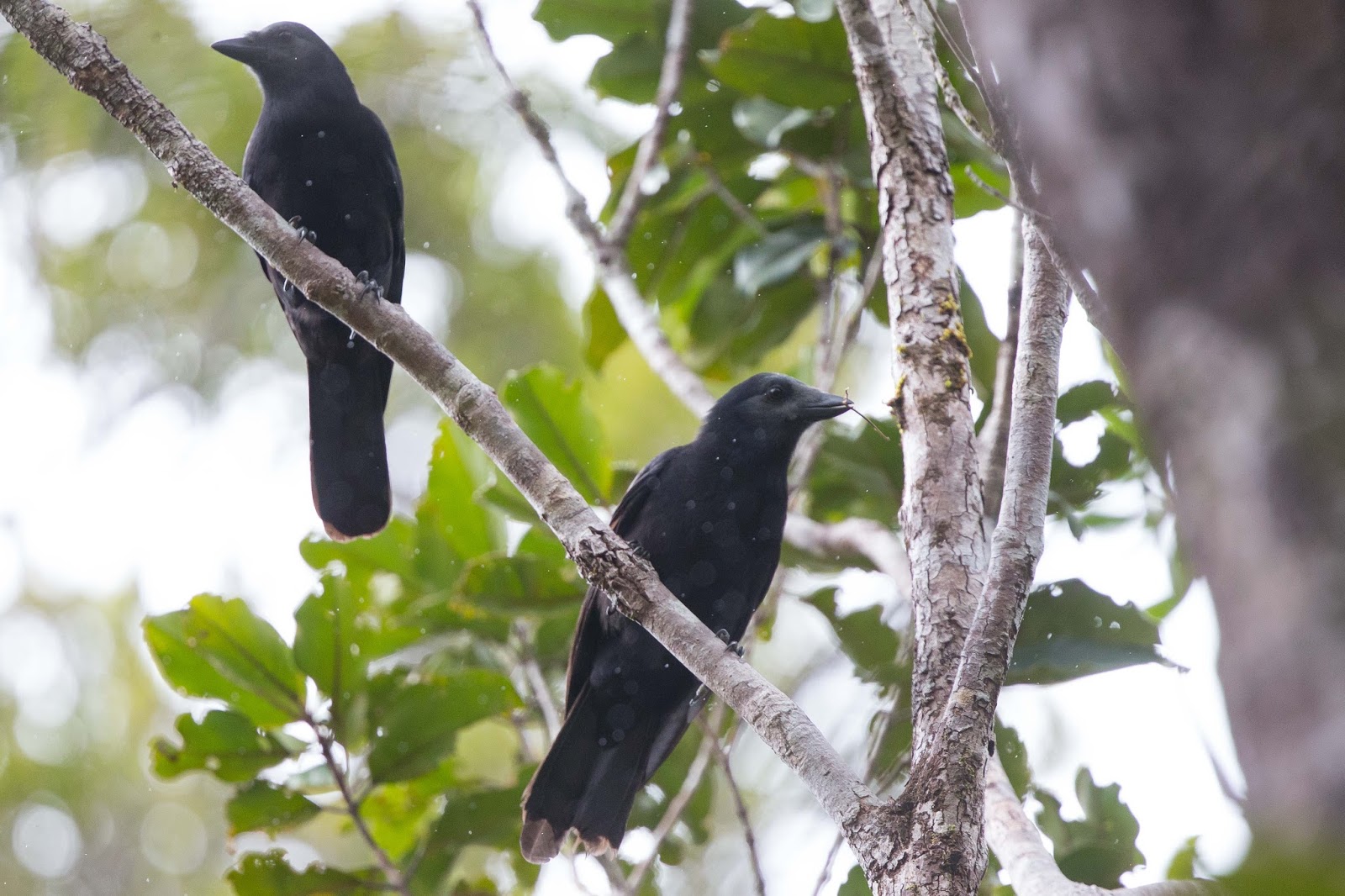
Further birding produced New Caledonian Cuckoo-shrike, New Caledonian Myzomela, great views of Red-throated Parakeet and then a pic-nic of cheese and onion sandwiches, apples and oranges. We then birded a track for around two km, Southern Shrikebill, Barred Honeyeater, South Melanesian Cuckoo-shrike, Long-tailed Triller and then another intriguing bird, the tool using New Caledonian Crow, the only bird in the world known to use a tool. A group of four birds showed well with twigs in mouth poking and prodding flaking bark and beetle holes, they would grip the twig under the foot before calling thereby avoiding dropping the twig. These birds are able to craft different tools for different tasks, and are able to select and manipulate a tool dependent on the task at hand – okay, this is usually a tool to extract a grub from dead wood but nonetheless this is a remarkable feat. Clearly these were intelligent birds peering back at us as Jean-Mark deafened us with further calls of Crow Honeyeater and the like. Some interesting information on New Caledonian Crow tool use can be seen here.

Red-throated Parakeet- Parc Riviere Bleue, New Caledonia

New Caledonian Cuckooshrike - Parc Riviere Bleue, New Caledonia

Southern Shrikebill - Parc Riviere Bleue, New Caledonia

New Caledonian Crow - Parc Riviere Bleue, New Caledonia

New Caledonian Crow - Parc Riviere Bleue, New Caledonia

New Caledonian Crow, both of these birds were using their tools to probe the twigs 
they are standing on - Parc Riviere Bleue, New Caledonia

The rest of the day was more or less taken up with the delight (chore) of finding Crow Honeyeater. This was to prove a fruitless task but we did enjoy views of many of the birds we had seen before including a final encounter with a confiding Kagu as we left the park.

Kagu selfie - Parc Riviere Bleue, New Caledonia


At dusk, AD once again expertly navigated us back through Noumeau and we relaxed happy with the days birding on New Caledonia, an outing that had been reduced by the previous days cancelled flight.

Map of Parc Riviera Bleue

Links to other days of the trip

Wednesday, 23 December 2015

Australia, Fiji and New Caledonia - 24th November (Day 14)

We were up at 04:00 ready to transfer to the airport when Martin informed us that we had received tickets for flights from Fiji to Auckland (New Zealand) at 09:45 and then Auckland to New Caledonia (14:15) arriving in New Caledonia at 15:10. We had a leisurely breakfast and headed to the airport, seeing a cracking Fiji Parrotfinch on the hotel lawn as we left, and all went smoothly, the plane departed on time and we were off albeit a day late.

The stop in New Zealand was novel as I had not been to the islands before and we flew over Cape Reinga and south to Auckland. While taxiing and in the airport we recorded Northern Red-breasted Dotteral, Starling, House Sparrow, Sky Lark, Black-shouldered Lapwing and Black-winged Stilt – the first species on my New Zealand list. Our flight departed on time and we flew in over the spectacular reefs spotted with islands and parched land of New Caledonia arriving on schedule at 15:10.

We collected our cars from Hertz and after a quick stop for drinks birded a gravelled road lined with scrub extending east from the main highway along a river valley to the south of Toro. We recorded our first species for New Caledonia including Streaked Fantail, Rufous Whistler, Green-backed White-eye, White-breasted Woodswallow, Fan-tailed Gerygone and Grey-eared Honeyeater. At around 17:00 we headed south to our hotel in the capital Noumea and after AD deftly navigated the streets of the city we arrived at our hotel on the seafront, the Nouvata Park Hotel a massive tourist complex and quite alien in comparison to our previous accommodation. We popped out to a local grill, being provided with raw fish to cook on a hot slate and enjoyed cold beers while planning our now reduced time in New Caledonia. We had arranged a pelagic trip from Noumea and a charter flight to Lifou and Ouvea, islands to the east of the main island Grand Terre, these islands support a small number of endemics that we were keen to see. However, due to the lost day we had to drop one of these days and put to the vote the island trip was axed.

Fiji Parrotbill - Nouvata Hotel, Nadi, Viti Levu

Fiji Parrotbill - Nouvata Hotel, Nadi, Viti Levu

Cape Reinga, the northern tip of North Island, New Zealand

The west coast of New Caledonia

River valley south of Toro, New Caledonia

Rufous Whistler (male) of race xanthetraea - New Caledonia

Rufous Whistler (female) of race xanthetraea - New Caledonia

Green-backed White-eye - New Caledonia

Grey Fantail of race bulgeri - New Caledonia

Dinner in  Noumea, New Caledonia

Links to other days of the trip

Tuesday, 22 December 2015

Australia, Fiji and New Caledonia - 23rd November (Day 13)

We were up early ready to visit Vatu-i-Ra to see the breeding seabirds which occur there. These included Black Noddy, Brown Booby, Lesser Frigatebird, Black-naped Tern and Bridled Tern but the weather did not bode well being a continuation of the heavy rain and strong winds hat we had been experiencing for the past two days. We loaded the cars and discovered that one of the vehicles had a rear puncture, this started to cast doubts on the potential to visit the island. We collected Villi and then returned to the hotel where Martin had replaced the punctured tyre. After some conflab we all agreed that the timings for the island visit and the subsequent international flight to New Caledonia were too tight coupled with the heavy rain and high winds we abandoned the boat in favour of birding locally at Suva Point. We drove through the town and arrived at the point as the tide was falling, already gathered were around 50 Bar-tailed Godwit, 2 Pacific Golden Plover, 4 Turnstone and a Red Knot while on the playing fields were a further 47 Pacific Golden Plover. As the tide fell large numbers of waders gathered on the extensive sandflats with the above species being joined by Lesser Sand-plover, Whimbrel, Wandering Tattler, White-faced Heron and Pacific Egret. A fly over Swamp Harrier gave fantastic views. After a breakfast stop we visited a fuit-bat roost where both Samoan Fruit-bat and Tongan Fruit-bat were present, the latter having a black back while the former a brown back.

We began the drive back to Nadi at around 11:00 stopping en-route for a scan to sea which produced a few Greater-crested Tern, Wandering Tattler, Brown Booby and distant views of a shearwater species. In need of a drink we stopped at the Baravi Handicrafts ‘centre’ at Vantukarasa. As we departed Martin picked up some fruit-doves in the top of a tree, we initially identified these as Tongan Fruit-dove, a species we had half heartedly searched for on the previous journey from Nadi to Suva, it was a long-shot as previous records were from 12 years ago. However, reviewing the identification features it appears that these were probably female Many-coloured Fruit-dove, a far more likely species and clearly an easy mistake to make. Tongan Fruit-dove is a species of the small off-islands and not reported to occur on the main islands of Fiji, possibly due to predation by Fiji Goshawk.

We arrived at the airport in good time to find that our 18:10 flight to New Caledonia had been cancelled due to a blockade at the airport on Wallace and Fortuna. We were informed that we would fly early AM to Sydney and then onto New Caledonia. We were checked into a Tokatoka Hotel near the airport and relaxed while Martin rearranged the logistics for the New Caledonia element of the trip.


Bar-tailed Godwit of race baueri which is treated as a 
separate species by some - Suva Point, Viti Levu

Whimbrel of race variegatus - Suva Point, Viti Levu

 Swamp Harrier - Suva Point, Viti Levu

Birding the wind swept and grey Suva Point, Viti Levu

Uca perplexa a species of fiddler crab common on the 
mudflats and prey to Whimbrel and Bar-tailed Godwit - Suva Point, Viti Levu

Uca perplexa - Viti levu

Tongan Fruit-bat (top left with black back) and Samoan Fruit-bat 
(top right with brown back) - Suva Point, Viti Levu

Fruit-bats - Suva Point, Viti Levu

Greater-crested Tern - Suva Point, Viti Levu

Hindu funeral ceremony - Suva Point, Viti Levu

Andy B performs Knocking on Heavens Door with the band at the Tokatoka Hotel

Links to other days of the trip